
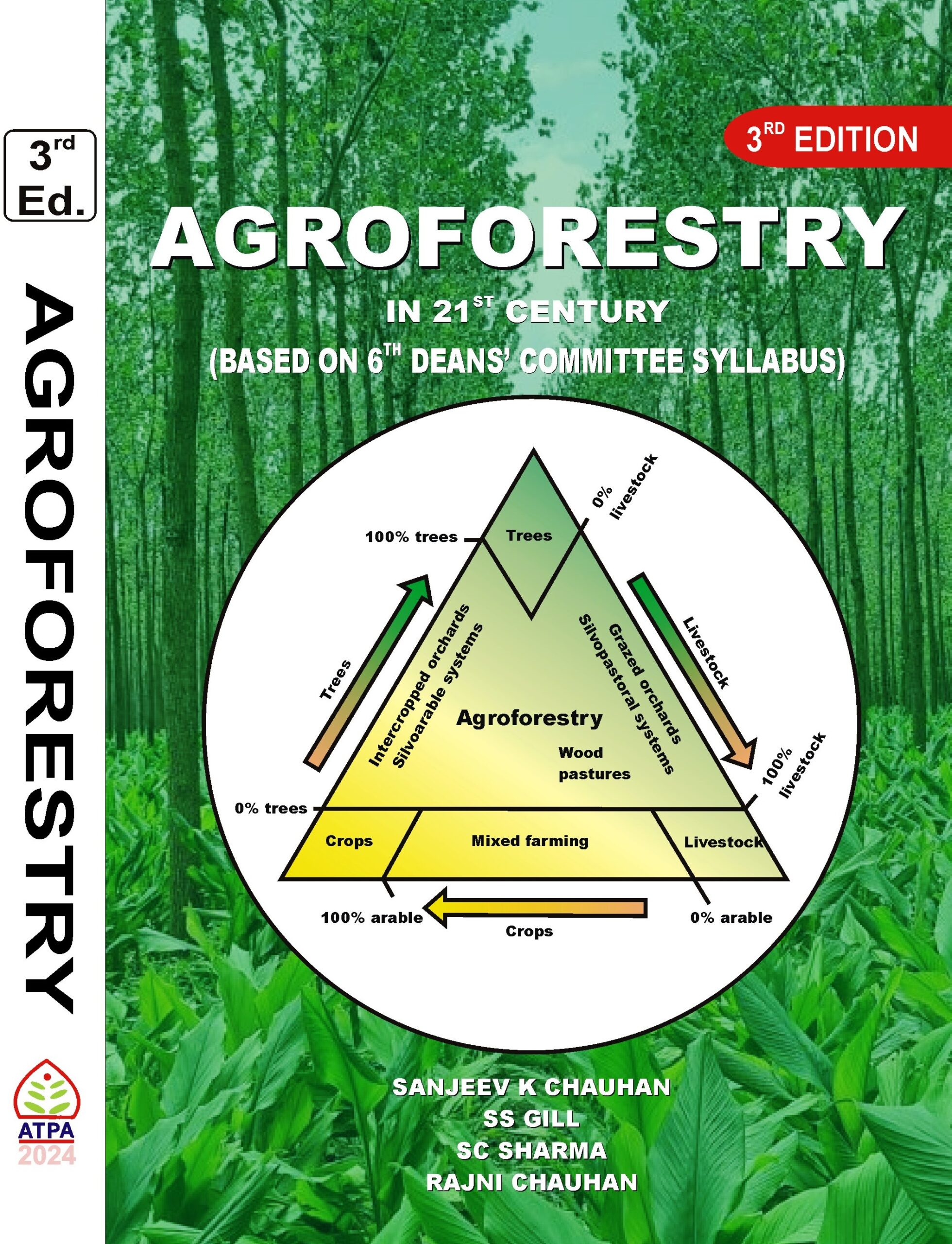
AGROFORESTRY (In 21st Century)
₹3,980.00
AUTHORS: SANJEEV K CHAUHAN, SS GILL, SC SHARMA AND RAJNI CHAUHAN
PUBLISHING YEAR: 2024
EDITION: 3RD
ISBN: 9788119319114
@ALL RIGHT RESERVED
Description
ABOUT THE BOOK
Under the given changed world seenario as a result of globalization of the trade, agriculture has also to be received as an industry. Following GATT agreement and the procedures of WTO, anything can be Including farm based products. It is therefore imperative that land is put under the most appropriate management system. Conventional or traditional system of management of farmlands is not going to work. It has to be competitive and oriented as per the needs of the day.
Agroforestry, tree plus crop together, as one of the farm management options has tremendous potential. This will not jeopardize the food security, area from agriculture can not be diverted to raise trees tofill the gap between demand and supply of wood based products. It is noble way of growing trees. In view of the growing emphasis on suitable forest management tree resource outside public forest have been receiving attentions at national and international level.
Agroforestry is ecologically sound as well tress adds to biodiversity and help in moderating the harsh climate. The leaf fall, underground roots, shade effects, reduction in soil erosion, etc. help in maintaining soil fertility. However, farmers will not spare their agricultural land for sole rising of trees, therefore agroforestry seem to be the only available option for maximum and sustainable productivity while preserving the environment.
Over the years, farmers have been integrating tree+crop+animal components for sustenance. With the passage of time, the agricultural components received priority over woody elements for sustaining self-sufficiency in food grains. The population pressure resulted in small holdings and consequently lesser number of trees on the farms providing food, fodder, fibre, fuel, fertilizer, fruit, etc. The introduction of high yielding crops has no doubt resulted in self sufficiency in food grains but its role in degrading natural resources can not be overlooked. In order to bring a balance between food sufficiency and ecological stability it is paramount to copy the nature by integrating different biota of life i.e., tree/sharubs/bushes, high value cash crops and/or animal husbandry. The traditional systems, which have been evolved by trial and error by our villagers, are to be preserved and improved by adding scientific input of tree+crop+animal modeling and by introducing superior genetic base in these polycultural systems. Agroforestry systems with their element of intercropping are similar to natural systems and have, therefore, an element of sustainability associated with them.
Today agroforestry is one of the important options for the diversification of agriculture in the country. It is a natural resource conserving system not resource depleting system. However, there is ample vacuum as regards biophysical and socio-economic processes involved in the component. Keeping in view the growing importance of the subject, this publication Agroforestry in 21st Century has been brought out for the ready reference of the readers on the recent developments in the field of agroforestry. These publications will help in plugging the vacuum in the knowledge base and support in shaping the future research programme in agroforestry. The publications will be helpful to the scientists, planners, managers, farmers and the students.
CONTENT
| S. No. | Chapter | Page No. |
| 1. | Thrust Areas in Agroforestry | 15 |
| 2. | Agroforestry Research in India : Myths and Realities | 23 |
| 3. | Promising Agroforestry Systems for Central India | 40 |
| 4. | Agroforestry in North-Eastern States : Its Present Status and Interventions for Future | 49 |
| 5. | Poplar Based Agroforestry Systems: A Sustainable Alternative to Rice-Wheat Production System | 56 |
| 6. | Bamboo Vegetable Farming and Agroforestry | 63 |
| 7. | Multivariate Analysis of Data From Agroforestry Experiments | 71 |
| 8. | Studies on Litterfall and Natural Grass Biomass Production Under
Eucalyptus tereticornis Plantation |
76 |
| 9. | Performance of Ceiba pentandra Under Different Planting Density and Their Effect on Productivity of Wheat in Agrisilvicultural System | 79 |
| 10. | Sustainable Planting System of Coffee-Silver Oak-Black Pepper in
Western Ghat Zone of Maharashtra |
83 |
| 11. | Effect of Tree Species on Growth and Yield of Rice (Oryza satiua L.) | 86 |
| 12. | Effect of Association of Tree Species on Grain Production of Intercrops | 90 |
| 13. | Effect of Different Shelterbelts on Plant Height and Fruit Yield of Capsicum (Capsicum annuum) | 93 |
| 14. | Periodic Changes in Crop Yield and Certain Characters in Casuarina equisetifolia Based Agri Sivlicltural System Developed on Sodic Wasteland | 97 |
| 15. | Response of Pruning and Tree Densities of Leucaena on the Biomass Productivity of Elephant Foot Yam Under Alley Cropping System | 102 |
| 16. | Shade Effect of Different Trees on Growth and Yield of Rice (Oryza satiua) Under Eastern Vidarbha Zone of Maharashtra State | 110 |
| 17. | Effect of Shelterbelts on Yield and Yield Contributing Parameters of Pea (Pisum Sativum) | 115 |
| 18. | Chemical Composition of Top Feeds of Konkan Region for Agroforestry System | 119 |
| 19. | Forage Yield and Quality of Guinea Grass (Panicum maximum) and Cowpeas (Vigna uniquiculata) in Association With Important Agroforestry Tree Species | 122 |
| 20. | Free Range Grazing in Coconut and Arecanut Based Silvo-Pastoral System in Andaman: A Review | 128 |
| 21. | Influence of Native Flora on The Performances of Crops as well as Environmental Parameters in Andaman | 135 |
| 22. | Growth and Yield of Turmeric Genotypes Grown in Mango Orchard of Western Ghat Zone of Maharashtra State | 142 |
| 23. | Scope for Intercopping of Medicinal Plants in Agroforestry Systems in Konkan Region | 146 |
| 24. | Effect of Eucalyptus Boundary Plantation on the Growth, Yield and Fruit Quality of Adjoining Pear and Guava Trees | 149 |
| 25. | Performance of Mustard Varieties Under Agroforestry System | 153 |
| 26. | Actual Productivity and Potential Productivity of The Soils of the Kandi Area for Growing Pastures and Forests | 157 |
| 27. | Effect of Different Shelterbelts on Soil Temperature and Canopy Temperature of Capsicum (Capsicum annuum) | 162 |
| 28. | Development of Agroforestry Systems Through Watershed Development Programme in India | 166 |
| 29. | Prospects of Populus deltoides in Agroforestry Systems : An Allelopathic Point of View | 170 |
| 30. | Marketing Direct and Indirect Carbon Fixation | 174 |
| 31. | A Commercial Way to Produce Quality Planting Stock of Agroforestry Tree Species | 183 |
| 32. | Nursery Techniques of few Agroforestry Tree Species of Andaman | 189 |
| 33. | Estimation of Variability in Branching, Production of Woody Cuttings and Rooting of Branch Cuttings in Selected Clones of Dalbergia sissoo Roxb. | 194 |
| 34. | Effect of Growing Media and Container Sizes on Growth and Development Behaviour of Dendrocalamus hamiltonii Munro Seedlings | 200
|
| 35. | Effect of Cutting Position and Size on the Nursery Growth Performance of Poplar (Populus deltoides Marsh.) | 206 |
| 36. | Influence of Season on Vegetative Propagation of Melia dubia through Stem Cuttings | 211 |
| 37. | In vitro Propagation Techniques in Acacia catechu – An Important Agroforestry Tree | 215 |
| 38. | Effect of Seed Treatments on Germination of Ornamental Trees | 222 |
| 39. | Growth of Acacia modesta Nursery Seedlings in Response to Different
Levels of Farm Yard Manure, Nitrogen and Phosphorus in two Soils |
225 |
| 40. | Rooting Behaviour of Seedlings of Nitrogen Fixing Tree Species | 231 |
| 41. | Evaluation of Planting Techniques for Neem (Azadirachta indica A. Juss ) : An Agroforestry Tree Species on Sodic Soils of Central Uttar Pradesh | 234 |
| 42. | Litterfall Pattern and Nutrients Returned in Soil by Acacia auriculiformis Under Konkan Conditions of Maharashtra | 238 |
| 43. | Managing Tree Roots for Enhancing Biomass Production in an Agroforestry Land Use from Uttaranchal Himalaya | 241 |
| 44. | Performance of MPTS on Lateritic Soil Conditions of Konkan | 246 |
| 45. | Studies on Tree Planting Technique Under Limited Water | 250 |
| 46. | Effect of Multipurpose Tree Plantatons on Physico-Chemical Properties of Soils | 254 |
| 47. | Survival Predictive Ability of Seedling Parameters in an Agroforestry Tree Species: Ulmus Villosa Royle | 259 |
| 48. | Seabuckthom – An Agroforestry Species of Cold Deserts of Himachal Pradesh | 269 |
| 49. | Germplasm Evaluation for Gum in Acacia nilotica : A Tree of Agroforetsry | 282 |
| 50. | Phenology and Reproductive Biology of Acacia nilotica (L.) Willd. ex Del. | 286 |
| 51. | Performance of Plus Tree Progenies of Shisham (Dalbergia sissoo Roxb.) | 290 |
| 52. | Grouping of Populus deltoides Clones on the Basis of Some Morphological Characters | 292 |
| 53. | Integrated Development of Agroforestry Plantations and Wood Based Industries | 296 |
| 54. | Short Rotation Leucaena Plantations for Rural Development and Industry in India | 304 |
| 55. | Potential Role of Ardu (Ailanthus excelsa) in Agroforestry Systems for Sustainable Rainfed Agriculture in Gujarat | 313 |
| 56. | Chemical Composition And Nutritive Value Of Gambhar (Gmelina arborea) Tree Leaves For Cattle | 316 |
| 57. | Effect of Pruning on Growth of Ain (Terminalia tomentosa) | 319 |
| 58. | Evaluation of Biofence Species Under Rainfed Conditions | 322 |
| 59. | Improvement of Ornamentals of Flyash Infested Area : A Study | 328 |
| 60. | Wild Ornamental Woody Shrubs for Various Landscape and Other Uses | 331 |
| 61. | Evaluation of Insecticides Against Defoliators of Populus ciliata in Himachal Pradesh | 341 |
| 62. | Potential of Natural Plant Extracts in Forest Insect-Pest Management | 345 |
| 63. | Insect Pests Associated with Traditional Agroforestry Trees/systems in Mid Hill Region of Himachal Pradesh | 354 |
| 64. | Diseases Interaction in Agroforestry Systems : The Jhansi Experience | 358 |
| 65. | Productivity and Carbon Storage Potential of Eucalyptus Hybrid Under Agroforestry System in Punjab | 365 |
| 66. | Farm Women’s Participation In Agroforestry Activities | 369 |
| 67. | Poplar Adoption V is -A -V is Socio-economic Status | 374 |
| 68. | Poplar Cultivation In South-Western Punjab : Problems And Policy Issues | 378 |
| 69. | Socio-Economic Perspective For Promoting Trees | 383 |
| 70. | Traditional Tree Fencing In Kandi Belt of Jammu Division | 391 |
| 71. | Effect of Nitro Substituent on Biological Activity of Schiff Bases | 394 |
| 72. | Fungitoxicity of Benzalaniline and N-Phenyl Derivatives | 397 |
| 73. | Potential of Ketimines of 2,5 Dimethoxyaniline for Fungicidal Activity | 400 |
| 74. | Comparative Fungitoxicity of Iron and Copper Complexes of Chloro Substituted Schiff Bases | 403 |
| 75. | Potential of 2 -P h en y l -4 – (a-Methyl m-Nitrobenzal)-5-Oxazolone As Fungicide. | 406 |
| 76. | Exploitation of Diimines of Aldehydes for their Antifungal Action | 409 |
| 77. | Antifungal Activity of 4-Methoxybenzal Derivatives | 412 |
| 78. | Nematicidal Activity of Aldimines of 2-Toluidine | 416 |
| 79. | Nematicidal Activity of 4-Thiazolidinones of 3,4,5- Trimethoxybenzalaniline | 419 |
| Proceedings of the National Symposium on “Agroforestry in 21st Century” | 422 | |
| Recommendations of the National Symposium on “Agroforestry in 21st Century” | 426 | |
| Author Index | 427 | |
| Subject Index | 429 |
ABOUT THE EDITORS
Dr. Sanjeev Chauhan, Ph.D. in Forestry has 11 years research, teaching and extension experience in the field of Forestry/Agroforestry. His main emphasis is on agroforestry and tree improvement research. He has published 35 research papers in national and international journals. He is member editorial Board of Indian Journal of Ecology. Dr Chauhan has been elected member of Indian Society of Agroforestry, and is referee Indian Forester. He is life member of number of professional societies.
Dr. SS Gill, Ph.D. in Horticulture from France is presently Professor and Head, Department of Forestry & Natural Resources, PAU Ludhiana. He has obtained advance training in Forestry from USA and is mainly emphasizing on nursery raising activities and micropropagation of agroforestry trees species. Dr. Gill remained coordinator of rural develoment centre of the Punjab State in University. Dr. Gill has a book to his credit besides 52 research papers.
Dr. SC Sharma, Ph.D. form Germany has a long experience on forest mensuration, watershed management and agroforestry. He joined Punjab Agricultural University after doing his M.Sc. from UHF Solan and is serving since then at ZRSKA.
Dr. Rajni Chauhan, Assistant Professor of Forestry (Ph.D.) is mainly working on ecological aspects and is emphasizing on mulberry and tahli improvement work from last nine years. She has 22 research paper published in national and international journals. She has worked as Principal Investigator of the adhoc project on reproductive biology of Dalbergia funded by ICFRE, Dehradun. She is also engaged in teaching and extension activities of the department.
Additional information
| AUTHOR/AUTHORS | RAJNI CHAUHAN, SANJEEV K CHAUHAN, SC SHARMA, SS GILL |
|---|---|
| PAGES | 432 |
| BINDING | Hard Back |
| PUBLICATION YEAR | 2024 |
Related products
-
-
HANDBOOK OF AGROFORESTRYS
- ₹1,500.00
-
-
-
TEXTBOOK OF INTRODUCTORY AGROFORESTRY
- ₹1,980.00
-
-
-
TEXTBOOK OF INTRODUCTION TO FORESTRY
- ₹1,980.00
-