
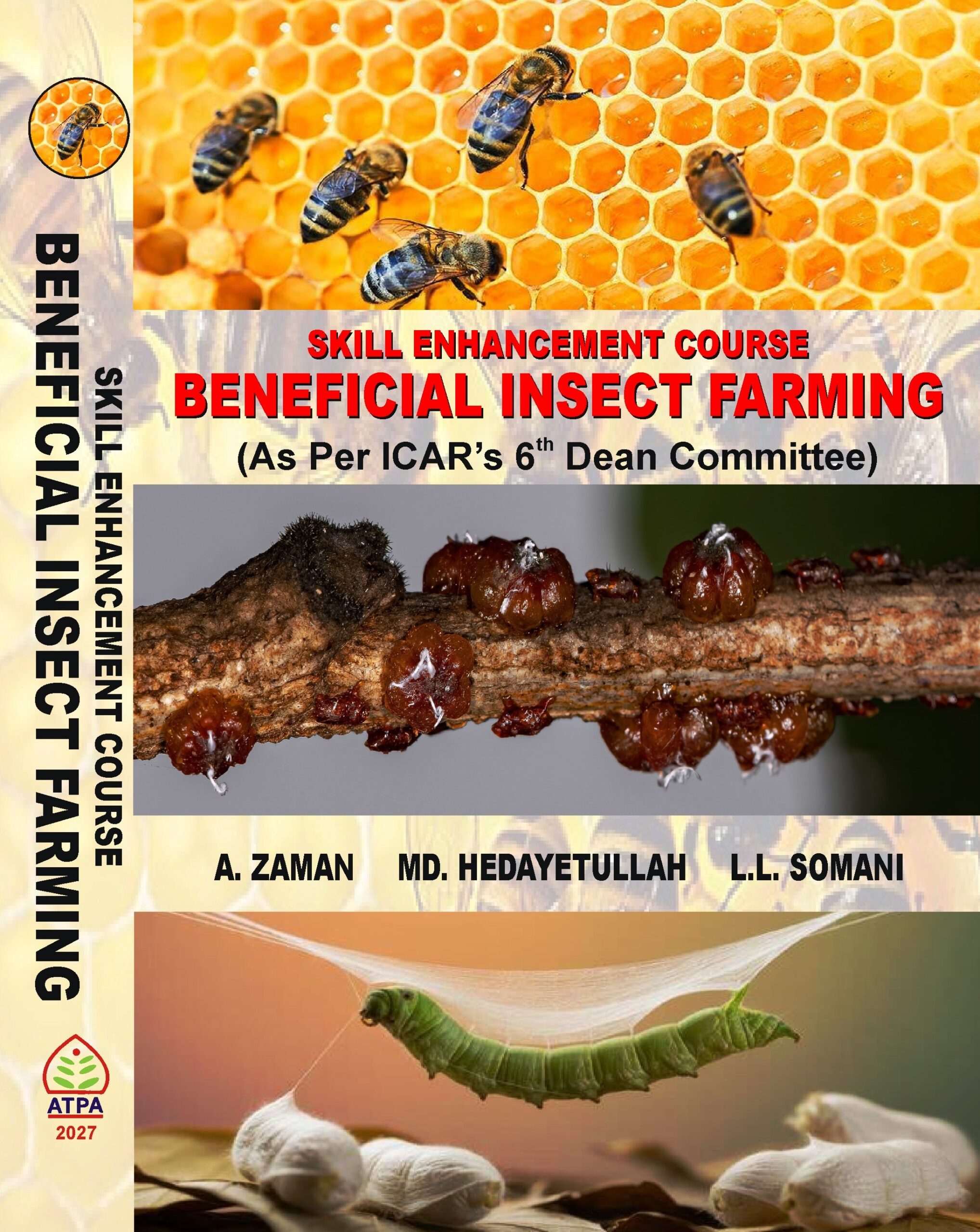
SKILL ENHANCEMENT COURSE BENEFICIAL INSECT FARMING
₹1,980.00
AUTHOR: A. ZAMAN and MD. HEDAYETULLAH and L.L. SOMANI
PUBLISHING YEAR: 2026
ISBN: 978-93-7188-087-9
@ALL RIGHT RESERVED
Description
PREFACE
The study the topic on “Beneficial Insect Farming” represents a vital intersection between traditional agricultural wisdom and modern scientific innovation. As global agriculture faces the dual challenges of climate change and the need for sustainable food security, the role of insects as both pollinators and producers of essential raw materials has never been more critical. This book, designed according to the ICAR’s 6th Dean Committee guidelines for the Skill Enhancement Course, serves as a comprehensive guide to three pillars of entomological industry: Apiculture, Lac Culture, and Sericulture.
Apiculture is far more than the production of honey and wax; it is the cornerstone of global biodiversity. By mastering the biology of honey bees and hive management, practitioners become essential stewards of our ecosystems, ensuring the pollination necessary for a significant portion of our food supply. This book offers a systematic approach to understanding bee behavior, health, and hive optimization, transforming beekeeping into a precise and sustainable science.
Lac Culture introduces the reader to the fascinating world of Kerria lacca. This agro-forestry practice highlights the potential for “green” manufacturing, utilizing natural resins to produce eco-friendly, biodegradable materials. By focusing on host tree management and insect inoculation, this section demonstrates how rural communities can transform underutilized land into productive hubs for high-value industrial resins, bridging the gap between forest-based livelihoods and the global pharmaceutical, cosmetic, and artisanal markets.
Sericulture rounds out the curriculum by detailing the intricate transformation of mulberry leaves into one of the most prized textiles in human history: silk. Beyond the technical aspects of silkworm rearing and cocoon harvesting, sericulture stands as a powerful tool for socioeconomic development. Its short production cycles and suitability for rural domestic environments offer a pathway to financial independence and women’s empowerment, proving that labor-intensive, small-scale farming can yield high-value luxury goods.
Collectively, these three disciplines dwelt with the beneficial insects form a robust framework for regenerative agriculture. This volume aims to equip students and practitioners with the technical expertise and management skills required to professionalize these practices. By integrating scientific rigor with sustainable field applications, this book provides the foundational knowledge necessary to succeed
in a rapidly evolving agricultural landscape. Whether one is interested in ecological preservation, industrial resin production, or high-value textile manufacturing, the study of beneficial insect farming offers a path toward a more productive and balanced future for our planet.
ABOUT THE BOOK
This comprehensive guide book on Hands-0n-Training under Skill Enhancement Courses for under graduate students across the disciplines approved by the ICAR, “Beneficial Insect Farming” serves as an essential resource book not only for the students but also for the practitioners in the field of agro-based industries. The book provides a structured, scientific approach to three foundational pillars of rural economy: Apiculture, Lac Culture, and Sericulture.
Part 1: Apiculture (Honey Production) This section explores beekeeping not merely as a hobby, but as a critical component of global food security. By detailing the biology of honeybees and the complexities of hive management, the book emphasizes their role as primary pollinators. Readers are guided through the entire lifecycle of apiculture—from species selection and queen rearing to disease management and the final processing of honey. It highlights the delicate balance between traditional husbandry and environmental stewardship, positioning beekeepers as vital caretakers of our ecosystems.
Part 2: Lac Culture (Resin Production) Focusing on the unique resinous secretions of the Kerria lacca insect, this section illustrates how nature provides sustainable, biodegradable alternatives to synthetic plastics. The text covers the intricacies of cultivating host trees like Palash and Kusum, the technical process of inoculation, and the subsequent purification of stick lac into valuable shellac. Given that India is a global leader in lac production, the book emphasizes its importance as a resilient income source for tribal and rural communities, demonstrating how agricultural waste-lands can be transformed into productive, eco-friendly assets.
Part 3: Sericulture (Silk Farming) The final section delves into the sophisticated world of sericulture, tracing the journey from mulberry cultivation to the production of high-value silk. It provides a technical roadmap for rearing Bombyx mori silkworms, emphasizing the importance of climate control, hygiene, and nutrition. Beyond the technicalities of reeling cocoons, the book addresses the socio-economic impact of sericulture, particularly its role in women’s empowerment and its ability to provide multiple cash flows throughout the year.
Conclusion “Beneficial Insect Farming” is a masterful synthesis of biology, technology, and economic strategy. By demystifying the management of these insects, it empowers learners to bridge the gap between traditional agricultural practices and modern industrial needs. Whether through the pollination services of bees, the industrial resin of the lac insect, or the luxury fibers of the silkworm, this book highlights how small-scale insect farming contributes to a sustainable, prosperous, and greener future.
CONTENT
| S. No | Topic/Content | Page |
| Preface | 3-4 | |
| About The Book | 7-8 | |
| About The Authors | 9-11 | |
| EXPERIMENT | ||
| PART-I: API CULTURE (HONEY PRODUCTION) | 13-96 | |
| 1 | Api Culture and Its Benefits | 15-21 |
| 2 | Selecting Suitable Bee Species for Farming | 22-28 |
| 3 | Studies on Castes of Bees | 29-33 |
| 4 | Environmental Conditions for Apiculture | 34-37 |
| 5 | Beekeeping Equipment and Setup | 38-45 |
| 6 | Hive Management and Maintenance in Api Culture | 46-52 |
| 7 | Feeding and Nutrition for Bees | 53-58 |
| 8 | Queen Bee Rearing and Breeding | 59-62 |
| 9 | Swarm Prevention and Control | 63-66 |
| 10 | Bee Disease Identification and Management | 67-70 |
| 11 | Pollination Services and Benefits | 71-73 |
| 12 | Safety Precautions in Apiculture | 74-77 |
| 13 | Honey Harvesting and Processing | 78-81 |
| 14 | Marketing and Selling Bee Products | 82-85 |
| 15 | Record Keeping and Sustainable Practices in Api Culture | 86-91 |
| Annexure | Economics & Benefit Cost Ratio in Apiculture (Honey Production) | 92-94 |
| References | 95-96 | |
| PART-II: LAC CULTURE (RESIN PRODUCTION) | 97-162 | |
| 1 | Importance of Lac Cultivation | 99-105 |
| 2 | Species of Lac Insect and Host Identification | 106-115 |
| 3 | Preparation and Management of Host Trees | 116-121 |
| 4 | Lac Inoculation Techniques | 122-127 |
| 5 | Environmental and Growth Monitoring in Lac Production | 128-132 |
| 6 | Pest and Disease Management in Lac Cultivation | 133-138 |
| 7 | Harvesting Lac Resin | 139-143 |
| 8 | Processing and Purification of Lac Resin | 144-148 |
| 9 | Storage and Preservation of Lac Resins | 150-153 |
| 10 | Marketing and Value Addition in Lac Production | 154-156 |
| Annexure | Economics & Benefit Cost Ratio in Lac Culture (Resin Production) | 157-158 |
| References | 159-161 | |
| Part-III: Seri Culture (Silk Production / Mulberry) | 163-232 | |
| 1 | Sericulture and Its Significance | 165-168 |
| 2 | Silkworm Breeds and Biology | 169-174 |
| 3 | Mulberry Cultivation and Variety Selection | 175-179 |
| 4 | Methods of Harvesting and Preservation of Mulberry Leaves | 180-189 |
| 5 | Environmental Conditions for Seri Culture/ Mulberry | 190-194 |
| 6 | Silkworm Rearing Techniques | 195-203 |
| 7 | Feeding and Nutrition Management of Mulberry | 204-208 |
| 8 | Disease Management in Silkworm/ Mulberry Rearing | 209-213 |
| 9 | Harvesting and Processing Mulberry for Silk | 214-217 |
| 10 | Quality Control, Marketing, and Export of Mulberry | 218-225 |
| Annexure | Economics & Benefit Cost Ratio in Seri Culture (Silk Production) | 226-228 |
| Reference | 229-232 | |
ABOUT THE AUTHORS
Professor (Dr.) A. Zaman, Ph D in Agronomy, is an internationally recognized scientist with 40 years of profound experience in agricultural water management. His ground-breaking and original research in fields such as irrigation water management, rainfed agriculture, cropping systems, watershed management, dry land agriculture, and biodiversity conservation has garnered global appreciation and established him as an outstanding teacher within farm universities worldwide. Dr. Zaman is credited with developing a wealth of original concepts, strategies, techniques, and tools that have profoundly contributed to agricultural science and benefited global society.
Born May 27, 1954, is a distinguished Agronomist specializing in Agricultural Water Management for enhancing crop and water productivity. His extensive career spans influential leadership roles at Bidhan Chandra Krishi Viswavidyalaya (BCKV) and Uttar Banga Krishi Viswavidyalaya (UBKV) in West Bengal, India. He has notably served as Dean, Faculty of Agriculture; Director of Research; Head of the Department of Agronomy; and Chief Scientist in AICRP on Water Management (ICAR). With significant research experience in water management, a background in post-graduate teaching, and considerable administrative acumen,
Since May 2020, Prof. Zaman has served as the Dean of the School of Agricultural Sciences at Sister Nivedita University, Kolkata. His extensive professional journey includes pivotal roles as Founder In-charge of Agriculture at The Neotia University (June 2018 to 2020), Emeritus Professor in Agriculture at M.S. Swaminathan School of Agriculture, Centurion University of Technology and Management (September 2016 – May 2018), and Programme Coordinator for the World Bank-funded West Bengal Accelerated Development of Minor Irrigation Project (September 2014 – August 2016).
Prior to these roles, Dr. Zaman gained invaluable international experience as Head of the Irrigation Expatriate Team for the Government of Uganda (1994-1996) under an ITEC Programme. In this capacity, he was instrumental in designing, laying out, and installing farmer-managed small-scale irrigation systems for sustainable crop cultivation. His vast academic contributions include authorship of 30 textbooks in agriculture, several book chapters, over 150 peer-reviewed research papers, and 179 publications in national and international seminar and conference proceedings. Furthermore,
he has significantly shaped future researchers, having guided 7 Ph.D. candidates and supervised over 50 postgraduate thesis works.
Dr. Md Hedayetullah, Assistant Professor in Agronomy, at Bidhan Chandra Krishi Viswavidyalaya, Mohanpur (West Bengal) is a dynamic and influential figure in contemporary agricultural science, bringing a distinctive blend of expertise spanning research, education, and extension policy implementation, and grassroots development.
He also leads the ICAR’s All India Coordinated Research Project (AICRP) on Chickpea, BCKV Centre. This pivotal leadership role places him at the forefront of national efforts to enhance pulse crops, driving the development of high-yielding, climate-resilient varieties and sustainable production technologies crucial for India’s nutritional security and farm profitability.
Dr. Hedayetullah earned his PhD in Agronomy from BCKV. His academic excellence was further recognized with the prestigious Maulana Azad National Fellowship, affirming his dedication to advanced scholarly inquiry and deep subject matter expertise.
His career reflects a comprehensive engagement across the agricultural ecosystem, consistently bridging the gap between scientific investigation and practical application:
As an Agronomist at the National Bank for Agriculture and Rural Development (NABARD): He gained crucial insight into agricultural finance, rural credit mechanisms, and the economic policies shaping farm performance and rural development.
As an Assistant Professor at the M.S. Swaminathan Institute of Agriculture Science: He focused intensely on sustainable development goals, conducting applied research and implementing innovative, environmentally sound farming practices.
As an Assistant Professor at the College of Agriculture, Tripura: He honed his dedication to academic instruction and mentorship, gaining a deep understanding of the challenges faced by emerging agricultural students and researchers.
A prolific author and dedicated mentor, Dr. Hedayetullah has guided 8 M.Sc. and 2 PhD students to successful completion. His extensive scholarly output includes 15 books (authored or co-authored), over 50 peer-reviewed research papers in leading national and international journals, and numerous specialized book chapters. He serves as Principal Investigator for several major externally funded research projects, underscoring his capacity to lead complex scientific initiatives. His commitment to bringing scientific knowledge directly to farmers and the public is evident through extensive engagement in live television talks and impactful farmer training programs. Blending elite academic credentials, comprehensive experience spanning agricultural finance and field research, and a clear commitment to public outreach, Dr. Hedayetullah stands as an authoritative and inspiring guide for students beginning their journey in agricultural science.
Dr. L.L. Somani, Retired Director Resident Instructions, MPUAT, Udaipur has many papers published in national and International Journals/Symposia, etc. and many number of books to his credit in different disciplines of Agriculture. He held different position in MPUAT and has spreaded highly innovative ideas and programmes for the development of Agriculture.
Additional information
| AUTHOR/AUTHORS | A. ZAMAN, L.L. Somani, MD. HEDAYETULLAH |
|---|---|
| PAGES | 232 |
| BINDING | Hardbond |
| PUBLICATION YEAR | 2026 |
Related products
-
-
TEXTBOOK OF HI-TECH HORTICULTURE
- ₹2,980.00
-
-
-
TEXTBOOK OF INTRODUCTORY AGROFORESTRY
- ₹1,980.00
-
-
-
PROBLEMATIC SOILS DIAGNOSIS & MANAGEMENT
- ₹1,500.00
-