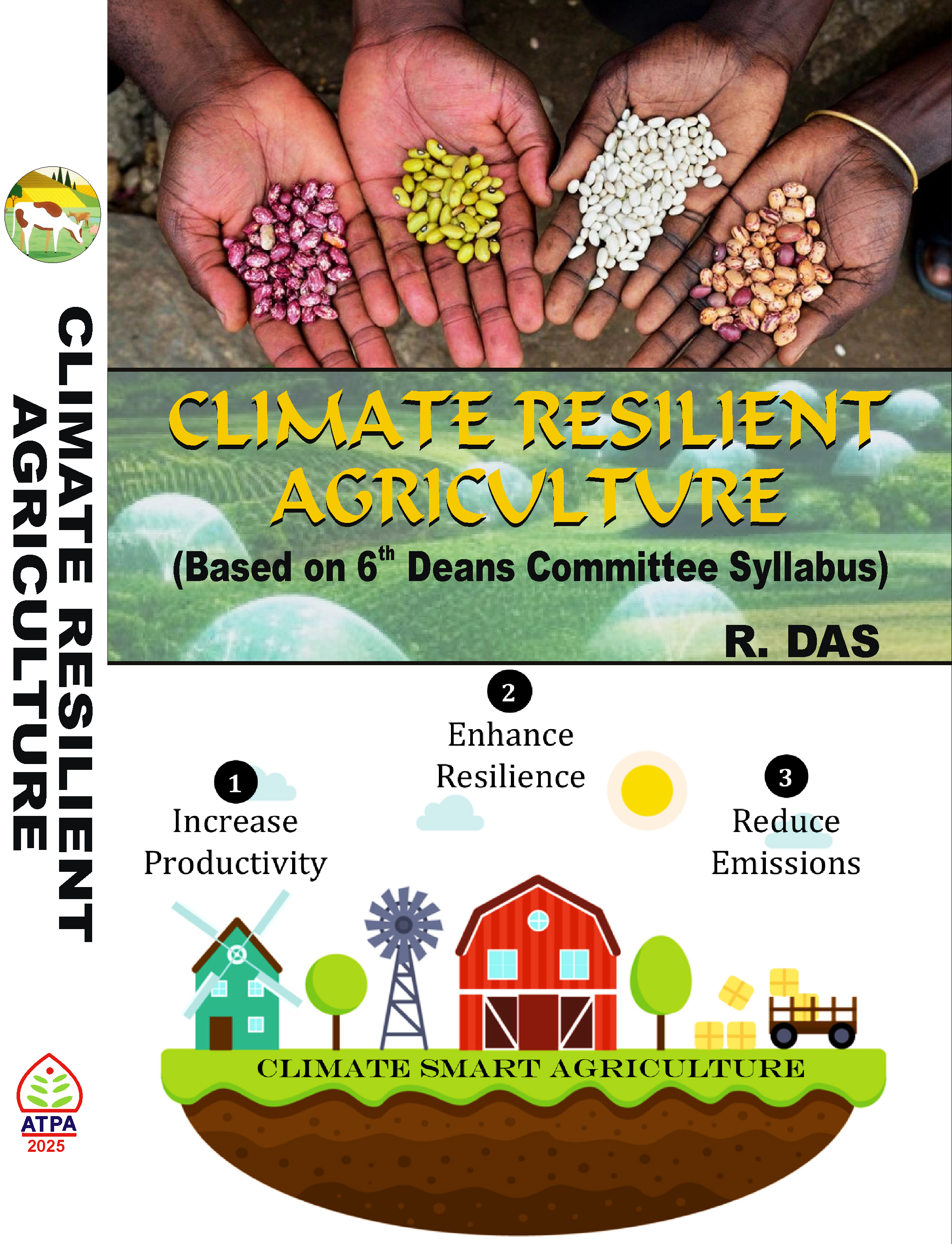
CLIMATE RESILIENT AGRICULTURE
₹3,500.00
AUTHOR: R. DAS
PUBLISHING YEAR: 2025
ISBN: 9788119892006
@ALL RIGHT RESERVED
Description
ABOUT THE BOOK
Societies, cultures and economies in the world’s history have successfully developed by mastering their abilities to adapt to climatic conditions. However, the last decades have been characterized by a dramatic growth in human population that is imposing unprecedented pressures on natural ecosystems and on existing agricultural production systems. In addition to this pressure, societies are expected to face changes in climate at also unprecedented rate. Agricultural production systems will require effective adaptive strategies to overcome these expected pressures in the immediate future.
Increasing climatic variability associated with will result in considerable seasonal/annual fluctuations in food production. All agricultural commodities even today are sensitive to such variability. Droughts, floods, tropical cyclones, heavy precipitation events, hot extremes and heat waves are known to negatively impact agricultural production, and farmer’s livelihood.
Climate change is one of the most important global environmental challenges in the history of mankind. The accelerating pace of climate change, combined with global population and income growth, threatens food security everywhere particularly in the developing countries. Assuming a global temperature rise of 4.4°C by 2080 over the cultivated areas, India’s agricultural output is projected to fall by 30-40% which would be quite alarming unless proper remedial measures are taken. Further, occurrence of new diseases, pests together with severity of the existing ones is also foreseen. The impacts of climate change on Indian continent are less explored and less known till now making the future scenarios more uncertain for vulnerability assessment and risk management. This book is an effort to quantify the climate-change impacts, assess the consequences for food security and estimate the investments that would offset the negative consequences for human well-being.
CONTENT
| S. No. | Title | Page |
| Foreword | 3 | |
| Preface | 4 | |
| About the Book | 5 | |
| About the Editor | 6 | |
| CHAPTER | ||
| 1. | Crop Responses to The Elevated CO2 : A South Asian Effort | 11 |
| 2. | Bio-Sequestration of Carbon Dioxide Through Microalgal Technology | 17 |
| 3. | Influence of Environmental Stress on Adaptation and Conservation of Medicinal Plants | 23 |
| 4. | Impact of Climate Change and Other Factors on Honey Bees | 44 |
| 5. | Carbon Dioxide Enrichment Technologies for Crop Response Studies | 50 |
| 6. | Soil Erosion vis-a-vis Climate Change | 56 |
| 7. | Physiology and Molecular Biology of Waterlogging Tolerance in Crop Plants | 62 |
| 8. | Salinity Stress Tolerance in Crop Plants | 77 |
| 9. | Shifting Cultivation and Climate Change | 85 |
| 10. | Green House Gas Emission From Agriculture and Their Mitigation Strategies | 97 |
| 11. | Climate Change: Impact on Medicinal and Aromatic Plants | 104 |
| 12. | Conservation Agriculture for Enhancing Resource Use Efficiency and Sustainability | 119 |
| 13. | Soil Carbon – Status and Spatial Assessment | 142 |
| 14. | Effect of Temperature Constraint on Some Indigenous Fermented Food Products | 163 |
| 15. | Indian Monsoons: Impact of Climate Change on Its Recent Trends | 172 |
| 16. | Recent Advances in Breeding for Drought Tolerance | 178 |
| 17. | Otc, Tgt, Face and Fate Technologies: A Tool for Environmental Research | 198 |
| 18. | Climate Change: Approaches and Strategies for Mitigation and Sustainable Development | 211 |
| 19. | Climate Change and Its Possible influence on The Occurrence of insect Pests | 217 |
| 20. | Climate Change: Some Research Strategies To Combat The Impact of Climate Change in Agriculture | 230 |
| 21. | Green Biotechnology: A Powerful, Innovative Technology To Mitigate Climate Change | 261 |
| 22. | Impact of Climate Change on Plant Diseases | 279 |
| 23. | Rice Under Abiotic Stresses | 298 |
| 24. | Water Harvesting-Concept and Potential in Climate Change Scenario | 317 |
| 25. | Biotechnology Research in Changing Climate Scenario | 324 |
| 26. | Acid Soils and Their Management | 327 |
| 27. | Climate Change, Green House Gas (Ghg) Emission and Some Mitigation Approaches | 336 |
| 28. | Strategies for Sustainable Agricultural Production Under Changing Climatic Condition | 346 |
| 29. | Food Security: Harnessing The Knowledge of Crop Research | 359 |
| 30. | Impact of Climate Change on Horticulture and Floriculture with a Special Reference To NE Region in india | 364 |
| 31. | Climate change and Some Related Social Issues : Reviews and Views | 376 |
| 32. | Enhancing Water Use Efficiency Under Present Context of Climate Change | 382 |
| 33. | Resource Conservation Technologies Under Changing Climate in Northwestern Himalayas | 387 |
| 34. | Storage of Harvested Rainwater and Its Proper Utilization for Irrigation and Other Uses | 405 |
| 35. | Climate Change and Its Impact on Nematodes | 411 |
| 36. | Impact of Fly Ash on Environment: Challenges and Prospects | 422 |
| 37. | Risk Analysis and Strategies for Its Management in Agricultural Production | 438 |
| 38. | Why India Should be Treated Differently from China Some “Inconvenient Truths” About the Chinese Economy and Emission | 444 |
| 39. | Strategies for Sustainable Agricultural Production Under Changing Climatic Condition | 451 |
| 40. | Moisture Stress and Crop Productivity | 464 |
| 41. | Carbon Sink Projects In A Post Kyoto Climate Regime | 527 |
| 42. | Upland Rice Environments and Culture of North Eastern India | 536 |
| 43. | Carbon Credit | 567 |
ABOUT THE EDITOR
Dr. Ranjan Das is Associate Professor of Assam Agricultural University, Jorhat, Assam. He has obtained his Ph.D. from Indian Agricultural Research Institute. New Delhi in Plant Physiology with specialization in climate change and stress physiology. Earlier Dr. Das worked in the capacity of a scientist in Remote Sensing Application Centre, Guwahati and gathering knowledge in simulation modeling, digital image processing and Geographical information system. After that he joined the Assam Agricultural University and has about 14 years of experience in teaching, research and extension. He has guided many postgraduate students and acted as a resource person in various trainings pertaining to climate change in different institutes all over India. He has also authored and co-authored a few books related to climate change and has numerous publications in national and international Journals. He has been the Zonal Secretary of Indian Society for Plant Physiology (East Zone) since last 6 years. He has worked extensively on crop response to climate change, carbon sequestration, limiting water and production physiology for sustainable development and currently he is handling three different projects related to climate change funded by ICAR and DST.
Additional information
| AUTHOR/AUTHORS | R. DAS |
|---|---|
| PAGES | 576 |
| BINDING | Hard Back |
| PUBLICATION YEAR | 2025 |
Related products
-

-
PRINCIPLES OF HUMAN NUTRITION
- ₹1,500.00
-
-
-
MEAT PROCESSING AND TECHNOLOGY
- ₹3,500.00
-