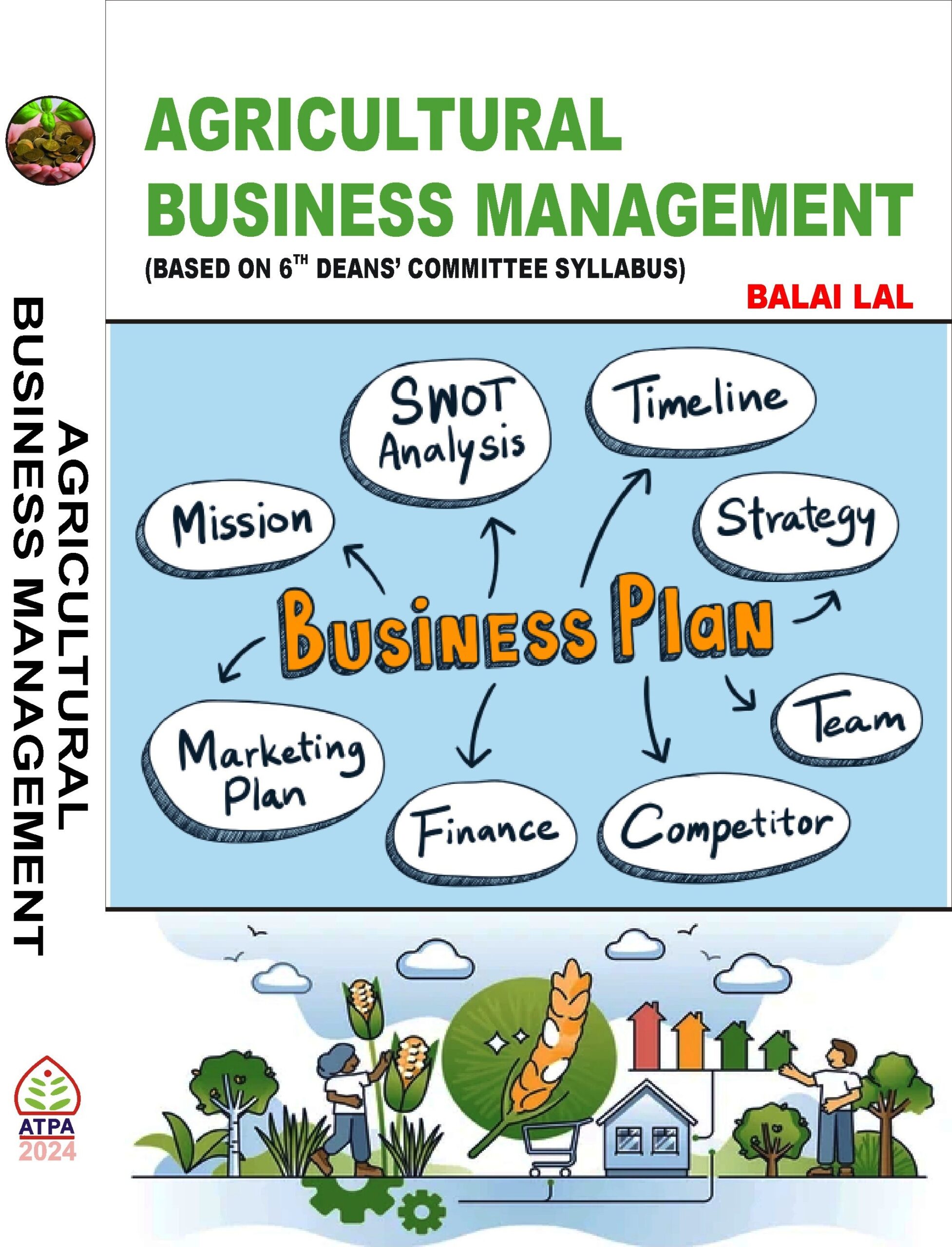
AGRICULTURAL BUSINESS MANAGEMENT
₹3,500.00
AUTHOR: BALAI LAL
PUBLISHING YEAR: 2024
ISBN: 9788119892334
@ALL RIGHT RESERVED
Description
ABOUT THE BOOK
The authour has been assigned to write this book entitled “Horticulture Business Management” and has followed the syllabai of the State Agricultural Universities (SAUs). It has been chalked out in 10 chapters comprising of the subjects, viz., Horticulture – Reaping Diverse Benefits, Horticulture Business Management and Programming, Horticulture Research in India for Accelerated Growth, Horticulture Export Scenario and Future Development, Organic Horticulture, Plant Propagation Methods, Horticulture Nursery Management, Ornamental Horticulture Nursery, Horticulture Development in India, Personnel Management Research in Agri-Business, Materials Management with Marketing Mix and Economic Order Quantity (EOQ), etc.
The author has highlighted the commercial value of Horticulture Business in all respect with the use of efficient technologies and modern researches, etc. that will surely augment the national progress reaching the goal of Vision – 2020. All these factors are subject to varying nature of risks, opportunities and feasibilities of enhanchanced socioeconomic security towards the farming community.
CONTENTS
| Preface | 3 | |
| Contents | 4-7 | |
| About the Book | 8 | |
| About the author | 9-10 | |
| 1 | Horticulture – Reaping Diverse Benefits | 11-99 |
| 1.1 | Introduction – Etymology – Understanding Horticulture – Areas of Study – Anthropology – Horticulture Organisation | 11 |
| 1.2 | Horticulture Business Management and Programming- Business Analysis and Benefits – Reaping Benefits from the Horticultural Business Analysis and Planning Programs- How do we participate in the Programs | 16 |
| 1.3 | Horticulture Studies and Research – Introduction – Why Horticulture Studies – Employment Potential – Opportunities in various sectors | 19 |
| 1.4 | Commercial Horticulture – Thrust Areas – Vegetables – Fruits – Floriculture – Mushrooms | 22-29 |
| 2 | Horticulture Research in India | 100-129 |
| 2.1 | Introduction – Research Infrastructure – Budgetary Support – Research Achievements – Iimpact of Research – Export of Horticultural Produce – Needs and Expectations – Genetic Resources – Crop Improvement – Crop Production – Crop Protection – Post Harvest Management – Biotechnology – National Problems – Conclusions | 100 |
| 2.2 | Research Preparedness for Accelerated Growth of Horticulture in India – Introduction – Technology Generation – Seed/Planting Material Propagation – Agrotechniques – Protection Technologies –
Post Harvest Management Technologies – Production Constraints – Research Strategies and Programs – Conclusions |
113-129 |
| 3 | Horticulture Export Scenario and Future Development | 130-154 |
| Introduction – Agro Sector Potential in India- Why our Exports are Low? – APEDA – Taking Horticulture Exports to New Heights – APEDA had initialed Right Practices at Farm Level – Technologies for Doubling the Production of Horticultural Crops – Critical Area for Intervention – Availability of Seed/Planting Material – Rejuvenation and/ or Rehabilitation of Existing Plantations – Fruit – Vegetable Crops – Ornamental crops – Control of Insects pests and Diseases – Installation of Drip Irrigation System – Efficient Post Harvest Handling – Human Resource Development and Imparting of Training – Expansion of Horticultural Crops in Potential Areas – Agricultural Sustainability in the 21st century – Conclusions. | 130 | |
| 4 | Organic Horticulture | 155-178 |
| 4.1 | Introduction – Objectives – Adverse Impact of Green Revolution (1967-1977) – Present Status of Organic Farming in India – Approaches for Organic Farming – General Information of Organic Horticulture – Organic Gardening System – Soil Nutrient Management – Pest Control Approaches – Pest, Disease and Weed Management – Conclusions | 155 |
| 4.2 | Understanding Supply and Demand is a basis for success in Horticulture – Market Forces – Demand – Factors determining Demand – Price increase normally produces a change in Demand For food consumption to increase, the population must increase; – Supply – Interaction of Supply and Demand – Some Factors that Determine Supply – Other Factors include – Conclusions. | 163 |
| 4.3 | Need for Organic Horticulture – Organic Horticultural Farming – Vermicomposting – Vermiculture and Vermicomposting – Conclusions. | 167-178 |
| 5 | Plant Propagation Methods in Horticulture | 179-205 |
| Introduction – Sexual and Asexual Plant Propagation – Seed Production and Seed Propagation – Vegetative Propagation – Budding, Layering and Grafting in Horticulture – Micropropagation and Hardening of Plants – Micro Propagation by using Ex-Plants – Hardening of the Tissne Cultured Transplants – Glossary – Points to Rember. | ||
| 6 | Horticulture Nursery Management | 206-224 |
| Introduction – Scope and Importance of Plant Propagation in Horticulture – Role of Nurseries in Horticulture Development – Types of Plant Propagation Nurseries According to Type of Plants – Types Nurseries according to type of Sale – Physical and Financial Resources for Nursery – Types of Plant Nursery Soil – Legal Authorization for sarting Nursery Business – Some other Resources required –Financial Resources for Nursery – Mother Plant Selection and Maintenance – Glossary – Points to Remember | ||
| 7 | Ornamental Horticultural Nursery | 225-260 |
| Introduction – Selection and Collection of Regional Ornamental Plants – Regional Demand and Supply Situation in Ornament Plants – Mass Production of Ornamental Plants – Nursery Plants Exhibition and Marketing – Commercial Display in Nursery – Marketing of Nursery Plants – Resources Used and Resource Efficiency Indicators – Productivity indicators – Net Returns and Profitability – Glossary – Points to Remember | ||
| 8 | Horticulture Development in India | 261-302 |
| Preface – Introduction – Area, Production and Productivity – Advantages of Diversification – R&D in Horticulture – Changing Scenario – Exports and Imports – Processed Fruits and Vegetables. | ||
| 9 | Personnel Management Research in Agribusiness | 303-326 |
| Introduction – Broad based Results & Reviews – Problem Statement – Farm Labour in the US – Objectives – Research Methods of Empirical Studies – Manager Conceptualization of Personnel Management Functions – Managers’ Personnel Management Competencies and Practices – Employees’ Job Attitudes and Job Satisfaction – Relationships between Personnel Management Practices and Organizational Outcomes – Conclusions. | ||
| 10 | Materials Management | 327-340 |
| 10.1 | Product – Product Catalog – Bill of Materials – Distribution and Multi-Warehouse control – Maternal Receipts & Replenishment – Costing of Product and Services. | 327 |
| 10.2 | Marketing Mix – Definition – The Marketing Mix and 4 PS: Understanding How to Position Your Market Offering – Understanding the Tool – Using the 4 Ps Marketing Mix Model. | 331 |
| 10.3 | Economic Order Quantity (EOQ) – Overview – Underlying Assumptions – Variables – The Total Cost Function – Extensions – Example. | 337-340 |
| References | 341-343 | |
| Subject Index | 344-350 | |
| Glossary | 351-368 | |
ABOUT THE AUTHORS
Balai Lal Jana (B.L. Jana) born on 2nd May, 1947 in the district of East Midnapore of West Bengal, stood First in the Higher Secondary Examination under the Board of Secondary Education, West Bengal in 1964 in Agricultural Stream; did B.Sc. (Ag.) Hons in 1968 and M.Sc. (Ag.) Agronomy in 1970 with first class form the Faculty of Agriculture, Kalyani University (now BCKV), with merit scholarships of the ICAR, DPI-West Bengal, Kalyani University, Ramakrisha Mission, Belur Math and the British Council. He obtained Diploma in Journalism and Mass Communication from Kolkata, certificate for Visiting Professional Training in Agricultural Research from the East Anglia University, Norwich, England; FAI training on Rainfed Agriculture in collaboration with ICRISAT, Hyderabad and HFC etc.
He served the erstwhile Fertiliser Corporation on India (FCI), subsequently the Hindustan Fertiliser Corporation (HFC) as a seniormost Senior Agronomist looking after field Promotional activities and Technical publicity, FP & ARD and ODA-funded Rainfed Farming Project, etc. Also served as the Training Organiser of ICAR –funded Krishi Vigan Kendra, Kalyan, Purulia district of West Bengal and as theTraining Organiser, Seva Bharati Krishi Vigan Kendra, Kapgari of Paschim Medinipore district of West Bengal.He has authored 21 nos. of Agricultural books in Bengali published by the West Bengal State Book Board, Pushpa Jana, Mehanati Prakashni, Bharati Book Stall, Kolkata and 20 other books in English published by the Agrotech Publishing Academy, Udaipur – 313001 (Rajasthan); Mehanati Prakashani, Kolkata; Pointer publishers, Jaipur – 302003. He has so far published 146 agricultural papers in English and 2000 articles in Bengali in the Journals of national and international repute. He was the Sub-Editor & is now Chief Advisor, ‘Sabuj Sona’ , an Agril.Fortnighty, Ranaghat (WB) and Edited the “Bhawna”, a House Journal of the Eastern India Pesticides Association (EIPA), Kolkata-700 026; ‘Soar Moti Fasal’ and ‘Prayas’ of HFCL; Annadata – bangala Monthly’ of ETV, Hyderabad, Ramoji Film City; and ‘Liebigs Krishi Bharata’ of Liebigo Agrochem, Kolkata, etc.
He has years of experience in the Rainfed Farming Project of HFCL in Eastern India supported by the Overseas Development Agency (ODA). He has given consultation services to the reputed Organisations like the Agricultural Finance Corporation (AFC); the Catholic Relief Services (CRS) – India Program, New Delhi; The SED India; The Bharat Chamber of Commerce, etc.He has been awarded the best journalist and writer for the year 2003, 2005 and 2006 respectively by the “Sobuj Sona” and recipient of the “Sabitri Devi Memorial Trust” award for his achievements in Farm journalism and dissemination of frontier technologies for the benefits of the farmers.
He visited England, attended seminars, workshops and corporate conferences of national and international status.
Additional information
| AUTHOR/AUTHORS | BALAI LAL |
|---|---|
| PAGES | 368 |
| BINDING | Hard Back |
| PUBLICATION YEAR | 2024 |
Related products
-
-
FUNDAMENTALS OF AGRIBUSINESS MANAGEMENT
- ₹2,500.00
-