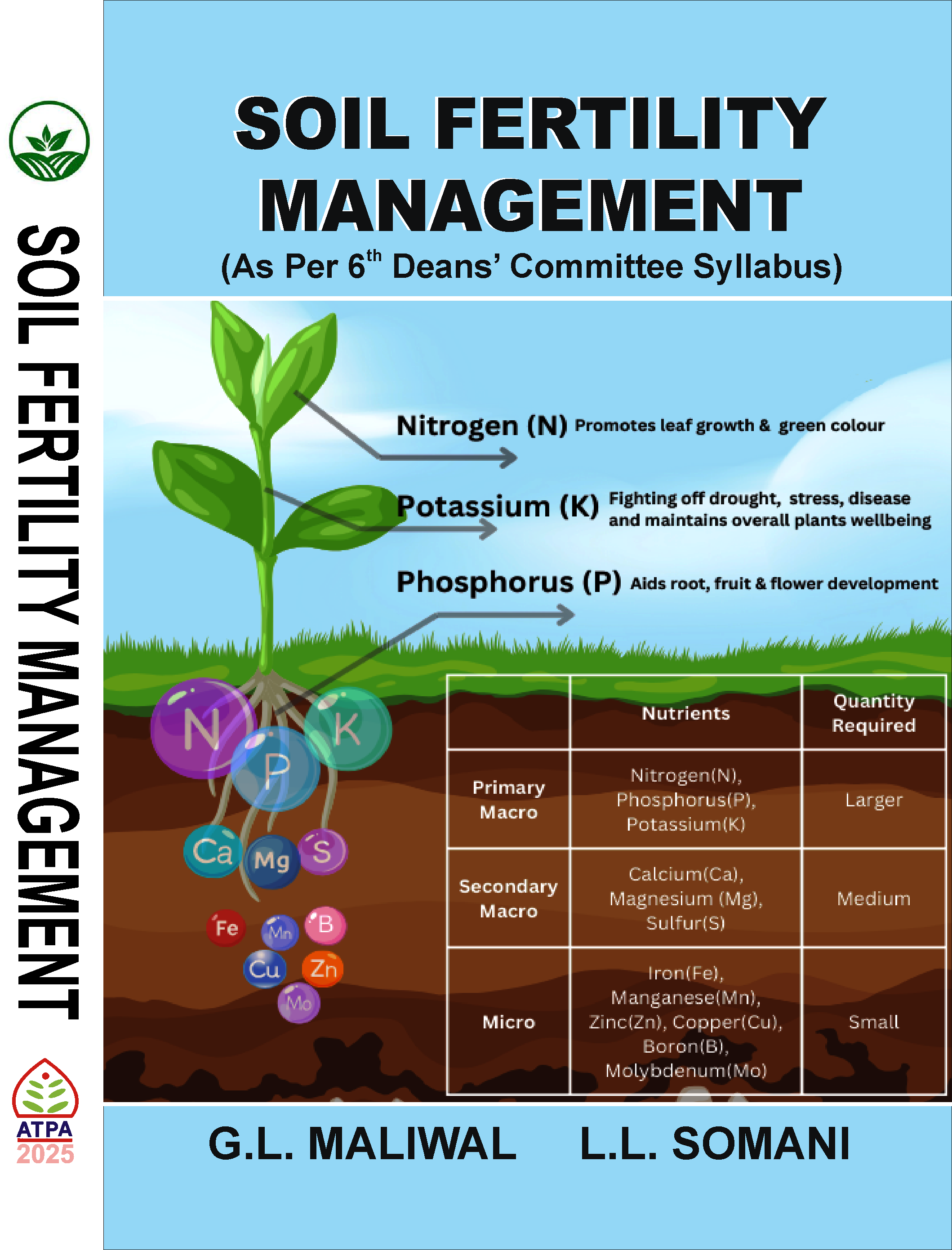
SOIL FERTILITY MANAGEMENT
₹1,980.00
AUTHORS: G.L. MALIWAL AND L.L. SOMANI
PUBLISHING YEAR: 2025
ISBN: 9788119892259
@ALL RIGHT RESERVED
Description
ABOUT THE BOOK
We’ve already learned that much of the world’s soils are becoming less fertile. But what exactly does soil fertility mean? Some define soil fertility simply as the capacity of the soil to supply nutrients to the plant. Using the definition, a fertile soil one that contains an adequate supply of all the nutrients required for the successful production of plant life.
Fertilization is an important issue because it is needed in order to produce enough food for the increasing population from the decreasing cultivated land, but too much or inappropriate use can be detrimental to the environment.
A productive soil should contain all the essential plant nutrients in sufficient quantity and in balanced proportions. The nutrients must also be present in an available form before plants can use them. Inadequacy of any one of these elements will inhibit plants from growing to their full potential.
This principle is probably best summed by the “Law of the Minimum” Propounded by Justus von Liebig in themed-1800’s This law states that if one of the nutritive elements is deficient or lacking, plant growth will be poor even when all the other elements are abundant. Any deficiency of a nutrient, no matter how small an amount is needed, will hold back plant development. If the deficient element is supplied growth will be increased up to the point where the supply of the element is no longer the limiting factor. Increasing the supply beyond this point is not helpful, as some other element would then be in a minimum supply and become the limiting factor.
No course on soil fertility management would be complete without some discussion of the fundamental reason why we are so interested in managing soil fertility – providing adequate nutrition for plants. It is very important to understand the basic nutritional needs of plants before going on to discuss the best ways to provide these requirements.
This book has been designed to meet the basic requirement of the course recommended by the 4th dean’s committee of ICAR. The book covers the whole syllabus in 16 chapters.
CONTENTS
| Preface | 3 | |
| About the Authors | 11 | |
| About the book | 12 | |
| 1. | Introduction | 13 |
| 2 | Plant Nutrition | 22 |
| 3 | Movement of nutrient | 36 |
| 4 | Nitrogen | 52 |
| 5 | Phosphorus | 79 |
| 6 | Potassim | 99 |
| 7 | Secondary Nutrients | 113 |
| 8 | Micronutrients | 136 |
| 9 | Soil Reaction and Buffering | 187 |
| 10 | Problematic Soils | 211 |
| 11 | Reclamation of Problematic Soils | 230 |
| 12 | Irrigation water | 247 |
| 13 | Soil fertility Evaluation | 269 |
| 14 | Fertilizers Recommendation | 297 |
| 15 | Nutrient Use Efficiency | 320 |
| 16 | Use of fertilizers and Insecticides in Agriculture | 330 |
| References | 344 | |
ABOUT THE AUTHORS
Dr. G.L. Maliwal saw the light of thee day on 16th November, 1942, obtained M.Sc. Ag. From Rajasthan College of Agriculture, Udaipur in 1965 and Ph.D. Degree from University of Udaipur, Udaipur in 1968. Dr. Maliwal had post doctoral research at Moscow State University, Krasnadar, USSR in 1968-1970. During last 38 years of active research and education Dr. Maliwal has made valuable contribution in the field of irrigation water quality, soil salinity, utilization of waste water in agricultural, water management and dry land farming, and guided M.Sc. Ag. and Ph.D. students. He held responsible positions at University of Udaipur, Udaipur (1966-76) and Gujarat Agricultural University (1976-2002). Before retirement, he was principal Investigator of the project on “Use of urban and industrial effluents in agriculture”, GAU, Anand Centre financed by World bank.
Dr. Maliwal was the active member of different expert committees constituted by state and central government in the field of salinity and pollution.
As a devoted researcher, authentic writer and critical reviewer, Dr. Maliwal has 210 original papers, books, bulletins and popular articles in national and international journals to his credit. He has made more than 80 recommendations for farming community and honoured by Sardar Patel Agricultural Research Award for the year 1988-89 by Givernment of Gujarat, Gandhinagar.
Dr. L.L. Somani, Retired Director Resident Instructions, MPUAT, Udaipur has many papers published in national and International Journals/Symposia, etc. and many number of books to his credit in different disciplines of agriculture. He held different position in MPUAT and has spreaded highly innovative ideas and programmes for the development of agriculture.
Additional information
| AUTHOR/AUTHORS | G. L. MALIWAL, L.L. Somani |
|---|---|
| PAGES | 352 |
| BINDING | Hard Back |
| PUBLICATION YEAR | 2025 |
Related products
-
-
PRINCIPLES OF SEED TECHNOLOGY
- ₹1,500.00
-
-
-
PRINCIPLES OF SOIL SCIENCE
- ₹1,980.00
-