INTRODUCTORY HORTICULTURE
₹1,500.00
AUTHOR: L.L. SOMANI
PUBLISHING YEAR: 2026
ISBN: 978-93-7188-886-8
@ALL RIGHT RESERVED
Description
PREFACE
Agriculture is the largest enterprise in India which has been and will continue to be the lifeline of the Indian economy in the foreseeable future. However, due to urbanization, agricultural land is shrinking and human population is increasing year by year. So, there is a need for vertical increase in agricultural produce to feed the increasing population. Due to changing climatic conditions, there is a need for reorientation of presently practiced agricultural technologies. At the same time there is a need to save/conserve the natural resources. In order to increase profit in agriculture, the farm inputs like seeds, fertilizers, irrigation water, herbicides, etc. must be used judiciously and more stress should be laid on conservation agriculture including organic farming, farming systems and cropping systems.
Importance of horticulture in India cannot be overemphasized. Its contribution in nutritional security and economic prosperity is well established. Horticultural crops are high value commercial crops, produce higher yields and income per unit area with enormous employment potential Recently several changes have taken place after the acceptance of liberalization policy and WTO provisions which have necessitated the need for competitiveness in the world trade market with respect to horticultural crops having potential for export. Demand on quality education and need based research in horticulture is increasing day by day.
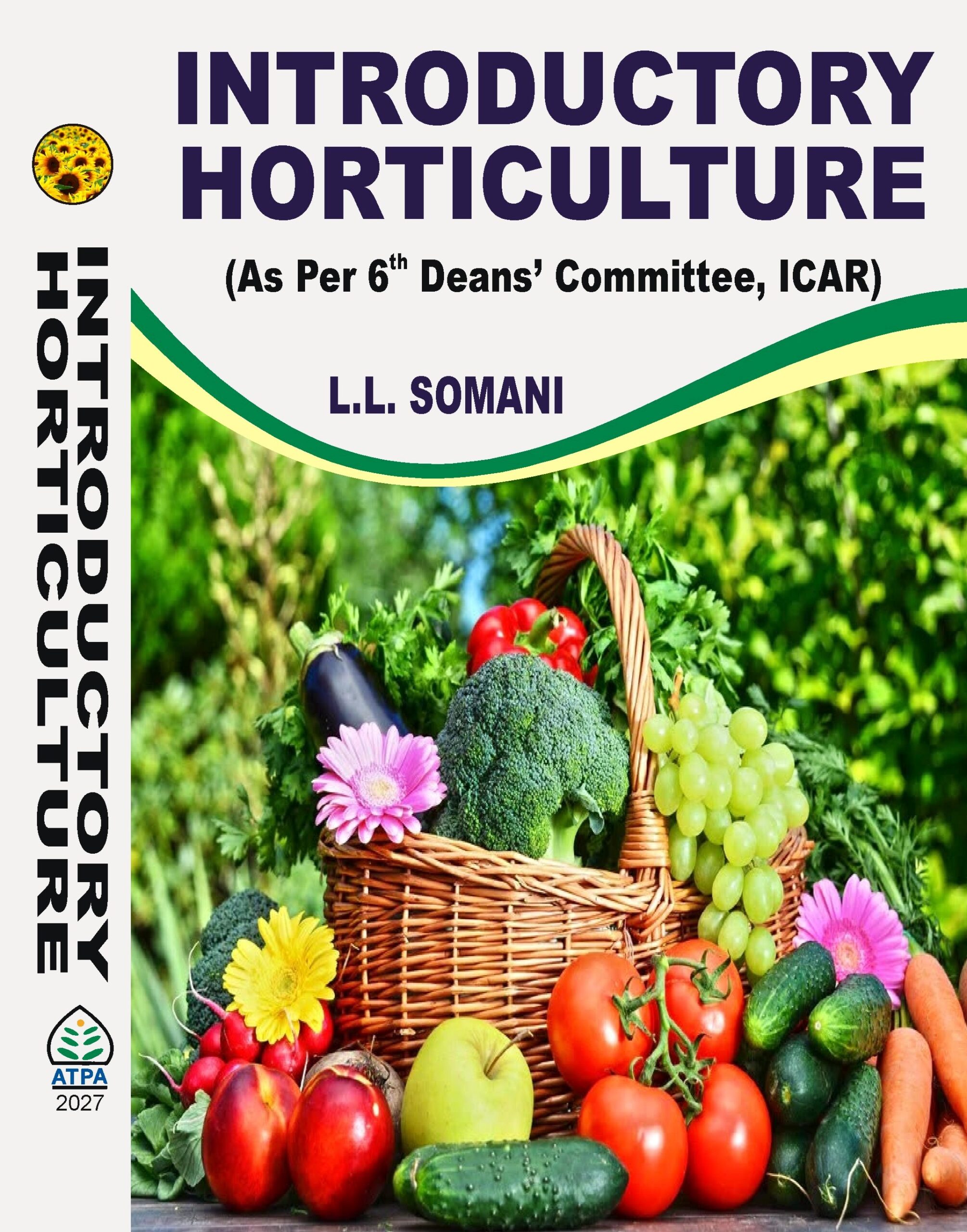
A number of courses have been indentified horticulture science of which the course on introductory Horticulture involving fundamentals of horticulture is important. In continuation of this exercise, it was pertinent to develop relevant literature on introductory principles of horticulture. To fulfil the requirement of this courses for B.Sc. (Ag.) as well as those of B.Sc. (Hort.) degree, this book entitled “INTRODUCTORY HORTICULTURE” is being brought out to meet the entire requirements of Syllabi Recommended by 6th Dean’s Committee of ICAR.
The book INTRODUCTORY HORTICULTURE covers basic but very comprehensive information on horticulture including Importance and Scope of Horticulture, Orchard Planning and Layout, Soil And Climate, Planting Systems, Pruning And Training, Use of Growth Regulators , horticulture zones of india, etc. The book will be very helpful for B.Sc. Agriculture as well as B. Sc. Horticulture students throughout the country as it covers nearby the entire syllabus for Fundamentals of Horticulture course framed by ICAR as suggested by 6th Dean’s Committee.
There is a great need of a textbook for UG students of SAUs as related Introduction to Horticulture. For overall success for a student it is quite essential that he has gone through all the finer points of which an examiner is looking for. The authors have made an excellent attempt to compile this book taking due care of the syllabi recommended by the 6th Dean’s Committee of ICAR. The book INTRODUCTORY HORTICULTURE is expected to serve as a ready material for all inquisitive minds to prepare for any traditional or internal grading system examinations, competitions and interviews, viva voce in the discipline of agriculture in general and horticulture in particular. We are sure that this book will be helpful to the students, scientist and teachers and aspirants looking for suitable jobs in the discipline of agriculture and horticulture.
ABOUT THE BOOK
Very often we ignore or miss the basic knowledge or information on which the multi-storeyed, multidisciplinary approach of crop production stands. It is strenuous strive to keep pace with the progress of such a vast subject like horticulture which is in practice throughout the world. Efforts have been made in this textbook to collet and collate new concepts of agronomy and horticulture into a somewhat single unit understandable to the undergraduate students and useful as a remedial course to the workers and scientist of agriculture and allied disciplines.
There is a great need of a textbook for UG students of SAUs as related Introductory Horticulture. For overall success for a student it is quite essential that he has gone through all the finer points of which an examiner is looking for. The authors have made an excellent attempt to compile this book taking due care of the syllabi recommended by the 6th Dean’s Committee of ICAR. The book is best suited for students preparing for competitive examinations such as JRF, SRF, NET, SLET, ASRB, IRMA, NABARD, Pre-PG, Ph.D. entrance exams, etc. INTRODUCTORY HORTICULTURE is expected to serve as a ready material for all inquisitive minds to prepare for any traditional or internal grading system examinations, competitions and interviews, viva voce in the discipline of agriculture in general and horticulture in particular. We are sure that this book will be helpful to the students, scientist and teachers and aspirants looking for suitable jobs in the discipline of horticulture.
All our strains will be worthy if the text containing basic concepts importance and scope of horticulture, Planning, Layout and Planting of Orchard, Training and Pruning, Use of Growth Regulators, Horticulture Zones of India etc. have been concisely dealt in separate chapters becomes helpful for whom this is made. The book will be very helpful for B.Sc. Agriculture and Horticulture students throughout the country as it covers nearly the entire syllabus for ‘Introductory Horticulture’ course framed by ICAR as suggested by 6th Dean’s Committee.
CONTENTS
| S.No. | TITLE | Page No. |
| Preface | 3-4 | |
| Syllabus | 5 | |
| About the Book | 6 | |
| About the Author | 8 | |
| CHAPTERS | ||
| 1. | Importance of Horticulture | 9-32 |
| 2. | Climatic Requirement | 33-37 |
| 3. | Soil Requirement | 38-41 |
| 4. | Types of Orchards | 42-46 |
| 5. | Establishment of Orchard | 47-49 |
| 6. | Planning of Orchard | 50-53 |
| 7. | Systems of Orchard layout | 54-60 |
| 8. | Planting Systems and Planting Densities | 61-69 |
| 9. | Orchard Management | 70-77 |
| 10. | Principles and Methods of Pruning and Training | 78-92 |
| 11. | Use of Growth Regulators in Horticulture Crops | 93-111 |
| 12. | Horticultural Zones of India | 112-115 |
| References | 116- | |
ABOUT THE AUTHOR
Prof. Dr. L.L. Somani is retired Director Resident Instructions MPUAT, Udaipur. He has organised the first ever seminar on Natural Farming (1992) and subsequently a National Symposium on Organic Farming (2001). He has authored several books like textbook of commercial production of spices and plantation crops, production technology of cool season vegetable crops, production technology of spices and plantation crops, commercial vegetable production, textbook on post-harvest managemebt of fruit crops, commercial production of flower crops, production technologies for horticultural crops, principles of hortuiculture, textbook of landscaping, textbook of commercial floriculture, textbook of ornamental horticulture, textbook of orchard and estate management, Handbook of Biofertilisers, Biodynamic Organic Farming, Composting Technology, Vermicomposting & Vermiwash, and Handbook on Green Manuring, Green Manuring for Sustainable Agriculture, Organic Recycling and Bioinoculants, etc.
Additional information
| AUTHOR/AUTHORS | L.L. Somani |
|---|---|
| PAGES | 116 |
| BINDING | Hardbond |
| PUBLICATION YEAR | 2026 |