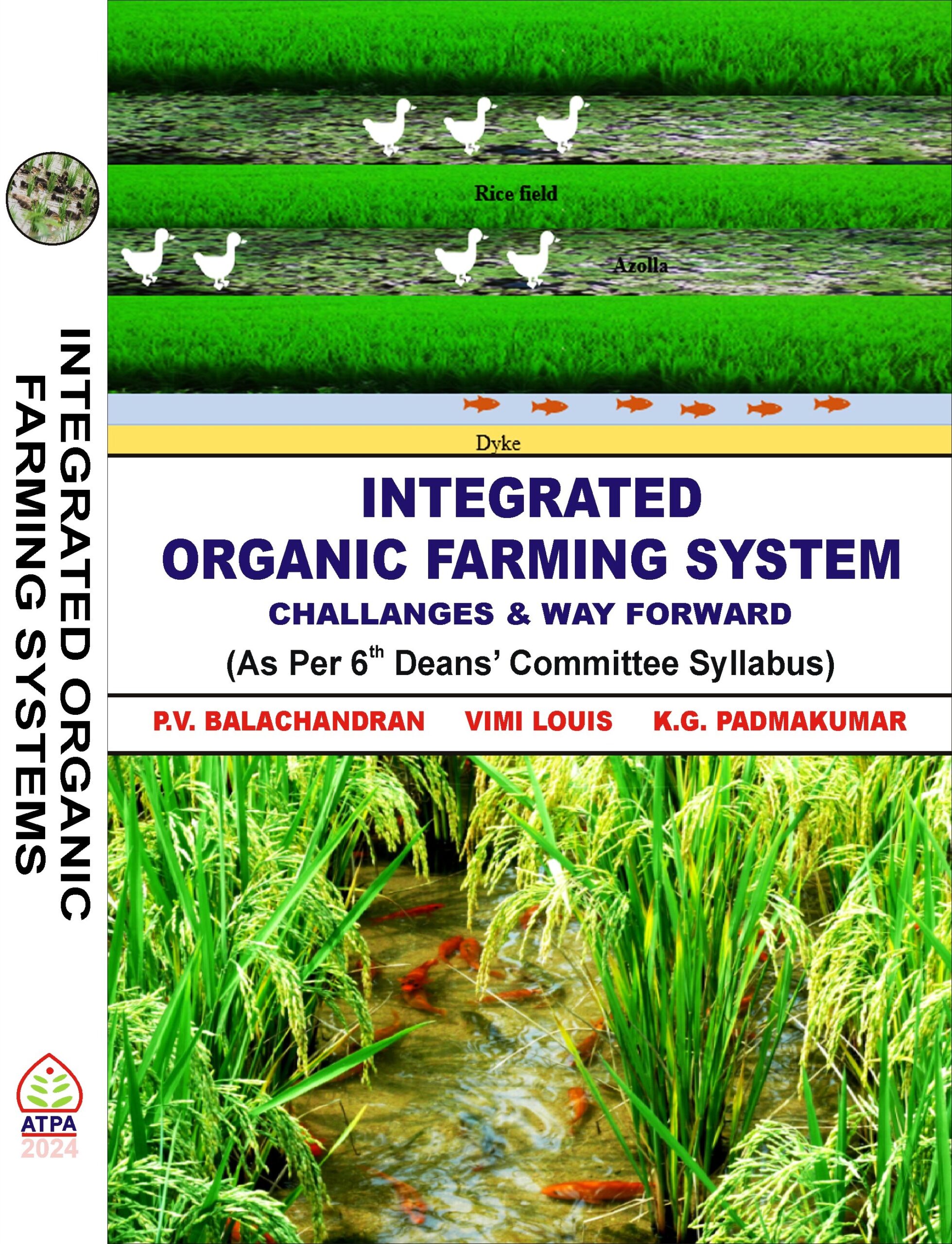
INTEGRATED ORGANIC FARMING SYSTEM (CHALLENGES & WAY FORWARD)
₹2,980.00
AUTHORS: P.V. BALACHANDAN, VIMI LOUIS AND K.G. PADMAKUMAR
PUBLISHING YEAR: 2024
ISBN: 9788119892433
@ALL RIGHT RESERVED
Description
ABOUT THE BOOK
To sustain the self sufficiency attained through green revolution it is necessary that we develop a suitable agricultural system, which will maintain soil fertility and productivity with greater acceptance of biological principles. Modern agriculture has led to the use of heavy doses of chemical fertilizers and pesticides, totally disregarding the health of soil and balance of ecosystem. Organic farming practices were known to our farmers since long but ere largely given up in recent decades for chemical farming. Organic farming has dual advantage of being sustainable without endangering the environment and being cost effective as there is very little input to be brought from outsides. It is thus essential to take a look at the present farming practices with emphasis on an integrated concept of sustainable farming, that enhances the quality of environment and natural resource base while ensuring increased productivity. The need of the hour is diversification of enterprises which produces multiple food from the same unit. A judicious mix of one or more enterprises that complement the cropping activity can result in increased farm income and recycling of farm residues. Introduction of fish as a complementary component of rice, under organic management, would be effective to make it sustainable and economically viable.
This publication brings out the various organic farming practices of growing rice in integration with fish and the different rice eco systems prevalent in the low lands of humid tropics. The various other topics discussed are the concept of organic farming, indigenous knowledge in organic farming systems of rice cultiva-tion, use of beneficial micro-organisms, choice of varieties in organic rice farming, rice-fish integrated systems, rice-prawn cultivation under Pokkali, vermitechnology, nutrient management, weed management, disease and pest management in organic rice-fish system.
CONTENTS
| S. No. | Title | Page |
| FOREWORD | 3 | |
| PREFACE | 4 | |
| ABOUT THE EDITORS | 5 | |
| ABOUT THE BOOK | 7 | |
| OUR CONTRIBUTORS | 8 | |
| 1. | Organic farming in Rice – An overview | 13 |
| 2. | Sustainable Agriculture and Organic Farming | 26 |
| 3. | National Programme on Organic Production (NPOP): Regulations on accreditation, inspection and certification | 34 |
| 4. | Rice is Life | 43 |
| 5. | Traditional and Appropriate Technologies for Agricultural Development of Kerala | 48 |
| 6. | Rice ecosystems in Kerala | 62 |
| 7. | Pokkali the world acclaimed sustainable farming system
model |
75 |
| 8. | Rice fish integration a win-win farming model for low lands | 86 |
| 9. | Relevance of choice of varieties for organic farming | 101 |
| 10. | Rice soils in coastal agro ecosystem-sustainable soil nutrient management in organic rice farming | 115 |
| 11. | Utilization of beneficial micro organisms for sustainable rice production | 126 |
| 12. | Crop rotation and residue recycling-Relevance in organic rice production | 138 |
| 13. | Pesticide residues in rice ecosystem | 146 |
| 14. | Changing concepts in the residual toxicity of pesticides | 157 |
| 15. | Biotechnological interventions in rice and its significance in organic farming | 172 |
| 16. | Indigenous knowledge in rice organic farming | 176 |
| 17. | Processing and value addition of organic rice | 184 |
| 18. | Weed Management in Organic rice | 188 |
| 19. | Biological suppression of aquatic weeds | 200 |
| 20. | Pest management in organic rice-fish system | 207 |
| 21. | Role of Pseudomonas in the management of rice diseases under organic cultivation | 217 |
| 22. | Management of rice diseases in organic rice fish system | 226 |
| 23. | Permanent manurial experiments and long term fertilizer experiment in Rice at R.A.R.S. Patttambi Sharing experience/Lessons learned | 242 |
| 24. | Application of vermiculture technology and methods of production of vermicompost | 261 |
| 25. | Economics of rice-fish integrated system under organic management | 270 |
| 26. | Biodynamic agriculture | 276 |
| Subject Index | 292 |
ABOUT THE EDITORS
Dr. P.V. Balachandran, a graduate in Agriculture, did MSc in Agronomy at Kerala Agricultural University and completed doctoral studies in 1982 at Indian Agricultural Research Institute, New Delhi. He was awarded Common Wealth Scholarship in 1985 to undertake postdoctoral studies at Long Ashton Research Station, University of Bristol, England. During the period from 1983 to 1999 Dr Balachandran worked at College of Horticulture. Kerala Agricultural University, Vellanikkara offering courses at graduate and post graduate levels. He has also guided several students for MSc and Ph. D. From 1999 onwards Dr. Balachandran has been working as Associate Dirctor of Research at Regional Agricultural Research Station, Kerala Agricultural University, Pattambi which is an internationally acclaimed research centre in paddy. It is from this station the first ever dwarf high yielding variety in paddy, Ptb-35 (Annapurna) was released for the first time in the country, in the year 1966. So far 57 high yielding rice verities suitable for the various agro climatic zones have been released from this station. Also under the Principal Investigator-ship of Dr Balchandran, a NATP funded project on organic farming in rice was undertaken at this station. In this project organic farming practices for rice were developed and it was also shown that rice could be successfully integrated with fish under organic management. Dr. Balachandran has published over 50 articles in National and International journals and has authored six books.
Dr. Vimi Louis is a graduate in Agriculture and did MSc and Ph.D in Plant Pathology with specialization in virology at Kerala Agricultural University. Dr. Vimi Louis who is presently working as Assistant Professor at Regional Agricultural Research Station, Pattambi has several publications in rice and rice based cropping systems to her credit.
Dr. K.G. Padmakumar is currently Associate Professor (Aquaculture) in Kerala Agricultural University, RARS, Kumarakom and has put in 30 years of research experience in aquaculture, Wetland ecology and Farming System Research. He has obtained Ph.D. Degree from the Central Institute of Fisheries Education (ICAR), Bombay University, in 1983 and has been engaged in evolving several farming system models for coastal wetlands and amongst these the rice-fish rotational faming model developed and popularized by him, known as ‘Oru Nellum Oru Meenum’ and the rice-fish-poultry multi integration model are considered win-win models widely lauded by the farmers of the region. The Govern-ment of Kerala has accepted this model as a policy option for rice farming development in Kerala. Dr. Padmakumar has worked as consultant to the Government for formulation of the rice-fish integrated farming project. He also worked as member of the expert committee on rice (Rice Commission, 1999), to formulate policies for rice farming development in Kerala. Dr. Padmakumar was awarded FAO Fellowship in 1995 for advanced studies in integrated fish farming and open water fish culture in the Peoples Republic of China. He has also been the Principal Investigator of several ICAR and Government of Kerala sponsored projects and has been instrumental in establishing an engineered fish sanctuary in Vembenad Lake, the first of its kind in the country. He has also developed breeding techniques for there cultivable freshwater endemic fish species of the Western Ghats and has authored a book ‘Captive Breeding for Conservation of Endemic Fishes of Western Ghats, India’.
Additional information
| AUTHOR/AUTHORS | K.G. PADMAKUMAR, P.V. BALACHANDRAN, VIMI LOUIS |
|---|---|
| PAGES | 304 |
| BINDING | Hard Back |
| PUBLICATION YEAR | 2024 |
Related products
-
-
FUNDAMENTALS OF FRUIT SCIENCE
- ₹1,980.00
-
-
-
CURRY LEAF
- ₹1,500.00
-