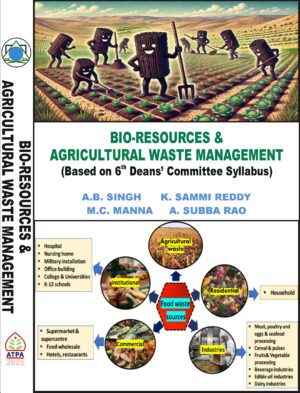

HANDBOOK OF BIO-RESOURCE & AGRICULTURAL WASTE MANAGEMENT
₹1,980.00
AUTHORS: A. SUBBA RAO, A.B. SINGH, K. SAMMI REDDY AND M.C. MANNA
PUBLISHING YEAR: 2025
ISBN: 9788119892983
@ALL RIGHT RESERVED
Description
ABOUT THE BOOK
The continuous use of high levels of chemical fertilizers is adversely affecting the sustainability of agricultural production and causing environmental pollution. There is a decline in the productivity of crop, despite the application of optimum levels of fertilizer inputs under assured irrigation. Constraint analysis has identified the declining organic mater status as a probable reason. It is in this context that the supplementation of organic along with chemical fertilizers is a decisive viable strategy.
In coming decades a major issue in designing sustainable agriculture system will be the management of soil organic matter and the rational use of inorganic inputs along with animal manures, crop residues, green manures, sewage sludge and food industry wastes. However, since organic wastes cannot meet the total nutrient needs of modern agriculture, integrated use of nutrients from fertilizers and organic wastes seems to be a need of the time.
Sustainable plant nutrition to increase food production has been identified as one of the priorities directly linked to land and water management resources in relation to environment. Therefore, the soil health is very important to achieve national food security targets for sustained growth.
Indian agriculture is operating at a net negative balance of plant nutrients at the rate of 8-10 million tonnes/annum. At least 10 million tonnes nutrients should come from organic manures, crop residues and bio-degradable wastes. Thus, food security is very much linked with nutrient input. India is endowed with enormous potential for plant nutrients locked up in the bio-degradable wastes. A total quantity of around 875 million tonnes of these so-called waste material is available in the country, which can supply 18.45 million tonnes of nutrients annually. This book orients towards recycling of biodegradable organic wastes for improved soil productivity.
CONTENTS
| S. No. | Title | Page |
| Preface | 3 | |
| About the Book | 4 | |
| About the Editors | 5 | |
| CHAPTER | ||
| 1. | Utilization of Cotton Crop Industry Wastes For Sustainable Crop Production | 9 |
| 2. | Recycling Crop Residues for Improved Nutrient Use Efficiency – A Case Study | 23 |
| 3. | Efficient Methods of Organic Wastes Recycling for Sustainable Agriculture | 32 |
| 4. | Recycling of Press Mud and Spent Wash in Agriculture | 59 |
| 5. | Soil Carbon Dynamics Under Long Term Use of Organic Manures | 83 |
| 6. | Recycling of waste and its quality assessment | 95 |
| 7. | Soil Organic Matter: Decomposition Process and Stabilization Mechanisms | 103 |
| 8. | Molecular Techniques to Explore Microbial Diversity in Soil and Environmental Samples | 119 |
| 9. | Mitigation Options for Greenhouse Gas Emission from Agriculture Fields | 135 |
| 10. | Wastes in Processing, Avenues to Value Addition | 153 |
| 11. | Modern Instrumental Techniques for Determination of Heavy Metals in Compost | 173 |
| 12. | Efficient Use of Manures Composts for Sustainable Crop Production in Organic Farming | 182 |
| 13. | Conservation Agriculture and Crop Residues (Management) Utilization | 199 |
| 14. | Heavy Metal Status in Different Compost and Their Permissible Limits | 209 |
| 15. | Potential for Different On Farm and Off Farm Organic Resources in India | 218 |
| 16. | Impact of Industrial and City Wastes on Soil Quality | 234 |
| 17. | Phytoremediation of Heavy Metals from Contaminated Soils | 264 |
| 18. | Organics as Important Component in Integrated Nutrient Management for Enhancing Long-term Productivity and Nutrient use Efficiencies | 272 |
| 19. | Soil Fertility Management and Soil Quality Under Organic Farming | 289 |
| 20. | Recycling Organic Materials as Soil Amendments | 306 |
| Subject Index | 339 | |
ABOUT THE EDITORS
Dr. A.B. Singh received his M. Sc and Ph.D in Biochemistry from Narendra Deva University of Agriculture and Technology, Faizabad. He served as Assistant Professor in CSK-HPKV Palampur (1992-99), Senior Scientist (1999-2007), and Principal Scientist (2007 onwards) at Indian Institute of Soil Science, Bhopal. He has made significant contributions in recycling of organic wastes, organic farming, vermicomposting, developing techniques for better soil biological health and produced quality etc. Dr. Singh has published over 50 research papers in National and International journals. He has received several awards and honors which include Vice Chancellor Gold Medal Award and Fellow of Indian Society of Agricultural Biochemists.
Dr. K. Sammi Reddy received his M. Sc. (Ag) in Soil Science and Agricultural Chemistry from APAU, Hyderabad and Ph. D. degree from IARI, New Delhi. He served as Scientific Assistant, National Remote Sensing Agency (NRSA), Hyderabad (1990-91), Scientist (1991-1998), Senior Scientist (1998-2008), and Principal Scientist (2008 onwards), Indian Institute of Soil Science, Bhopal.
He has made significant contributions in integrated nutrient management in soybean-wheat system, dynamics of N and S in different soils after long-term cropping, preparation and evaluation of thermally promoted phosphate rocks, and residual P management in soybean-wheat system on Vertisols. Dr. Reddy has published over 40 research papers in National and International journals. He has received several awards and honors which include PPIC-FAI Award (1997), The Golden Jubilee Commemoration Young Scientist Award of ISSS (2002), IMPHOS-FAI Award (2003), Associate Fellowship of NAAS, New Delhi (2006), TSI-FAI Award (2006), FAI Golden Jubilee Award (2008) for his valuable contributions in the field of nutrient management in soybean-wheat system. He has traveled to Australia, Kenya, Philippines, Thailand and Singapore and participated in Seminars/workshops or undergone short-term training.
Dr. M.C. Manna is Principal Scientist and Head, Soil Biology Division, Indian Institute of Soil Science, Bhopal. Fellow of Indian Society of Soil Science Recipient of 12th International Congress Commemoration Award and Imphos-FAI Award. He is involved in research in the area of waste recycling through microbial processes, soil carbon sequestration, soil carbon pools in relation to climate change.
Dr. A. Subba Rao, after completing M.Sc. (Ag.) in Agricultural Chemistry (1976) from Andhra Pradesh Agricultural University and Ph.D. in Soil Science (1980) from IARI, served as Assistant Professor, Andhra Pradesh Agricultural University, Bapatla (1980-1984), Soil Scientist, Potash Research Institute of India, Gurgaon (1984-89, Principal Scientist, Indian Institute of Soil Science, Bhopal (1987-97), Project Coordinator, Soil Test Crop Response Correlation (1997 – 2004) and Director (2004 -till date). He has made significant contributions in delineation of potassium supplying power of Indian soils, management of phosphorus in soybean-wheat system, dynamics of P and K in soil-plant system and soil-test crop response correlation study. Dr. A. Subba Rao is the Fellow of National Academy of Agricultural Sciences, India and Fellow of Indian Society of Soil Science (ISSS) and has also received several National Awards.
He has traveled to Australia, France, Germany, England, Philippines and Switzerland and presented papers in Seminars or undergone short-term training. Served as Member, Institute Management Committee, NRC Weed Science, Jabalpur; Indian Institute of Soil Science, Bhopal; Secretary, Research Advisory Committee and QRT, IISS, Bhopal and Member, Soil Quality Subcommittee, BIS.
Additional information
| AUTHOR/AUTHORS | A. SUBBA RAO, A.B. SINGH, K. SAMMI REDDY, M.C. MANNA |
|---|---|
| PAGES | 344 |
| BINDING | Hard Back |
| PUBLICATION YEAR | 2025 |
Related products
-
-
BIO-PESTICIDES AND BIO-FERTILIZERS
- ₹1,980.00
-
-
-
INTRODUCTORY GENOMICS AND BIOINFORMATICS
- ₹1,500.00
-