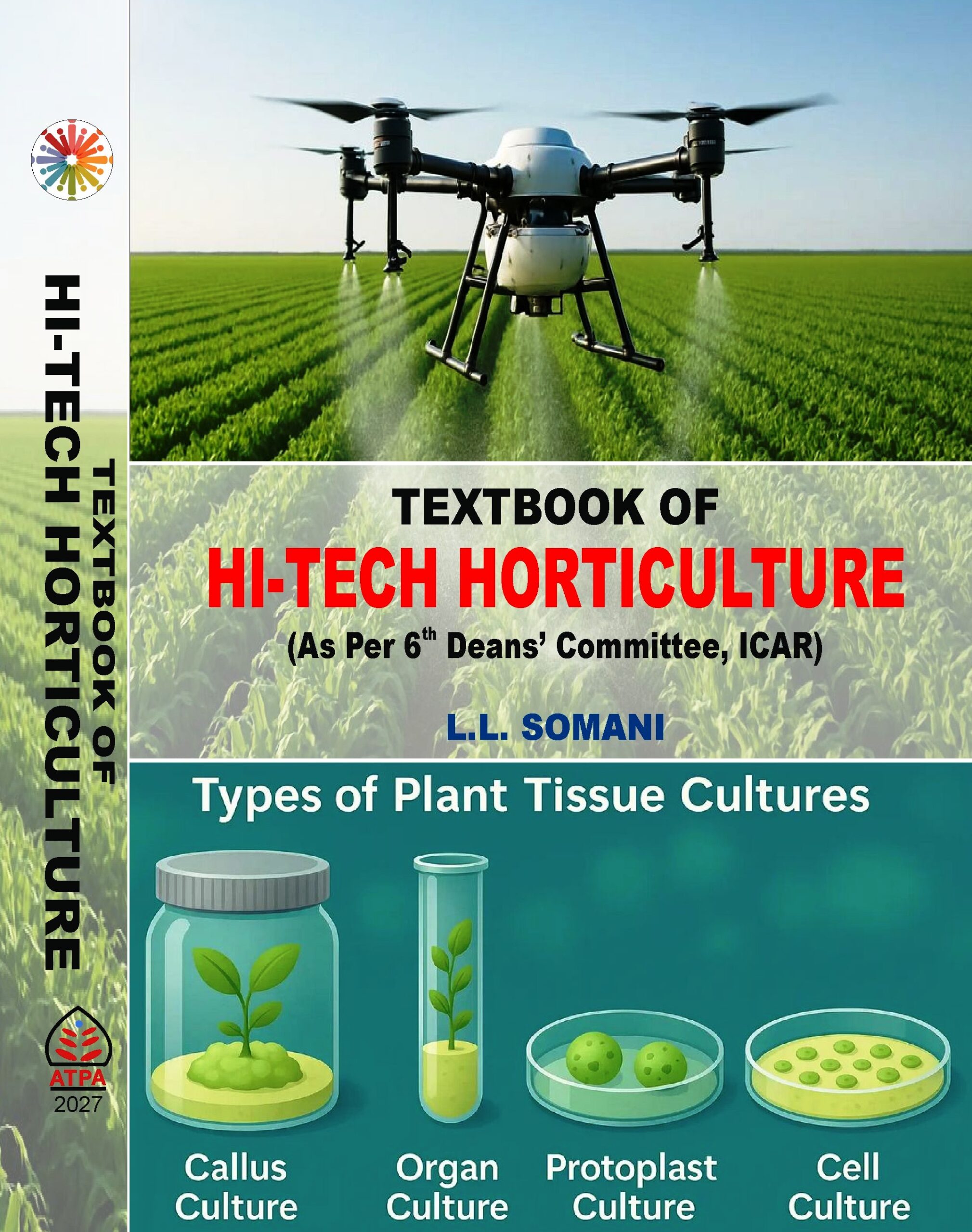
TEXTBOOK OF HI-TECH HORTICULTURE
₹2,980.00
AUTHOR: L.L. SOMANI
PUBLISHING YEAR: 2026
ISBN: 978-93-7188-013-8
@ALL RIGHT RESERVED
Description
PREFACE
Agriculture is the largest enterprise in India which has been and will continue to be the lifeline of the Indian economy in the foreseeable future. However, due to urbanization, agricultural land is shrinking and human population is increasing year by year. So, there is a need for vertical increase in agricultural produce to feed the increasing population.
Horticulture plays an important part in today’s agriculture and there are new avenues that are being achieved by horticulture. The subject has transformed from only being about vegetables, fruits, flowers and postharvest technology and has moved towards disease, breeding, pathology, physiology, greenhouse technologies and other areas which were never heard for. The book “Hi-Tech Horticulture” has been worked out keeping the above mentioned issues in mind with contribution by eminent professors and scientists
This book demonstrates applications of the basic principles of horticulture and illustrates how they can be used systematically to define—and eventually control—existing phenomena. It comprises of various practices for evaluating the technologies used in horticulture. It will meet the growing need of students, teachers, and researchers alike in the field of horticulture and those working in agricultural universities and other related private firms.
It discusses horticulture technology interventions like good agricultural practices like, optimum planting density, micro-irrigation, fertigation, precision horticulture, protected cultivation, technology, and the importance of attaining food and nutritional security through hi-tech horticulture and profitable marketing of horticultural produce is also discussed.
This book will be of immense value to the scientific community involved in teaching, research and extension activities related to hi-tech horticulture strategies for enhancing productivity in enhancing farmers’ income, food, and nutrition and livelihood security. The material can be used for teaching postgraduate courses. The book can also serve as a very useful reference to policymakers and practicing farmers.
ABOUT THE BOOK
This book highlights the underlying principles and outlines some of the key hi-tech practices and technology interventions required to achieve enhanced productivity.
The book titled “Hi-Tech Cultivation of Horticultural Crops” provides a comprehensive overview of both the theoretical and practical aspects of protected cultivation, presented in a concise and straightforward manner. It places special emphasis on key topics such as the scope and significance of protected cultivation, polyhouse structures, growing media, Hi-Tech Nursery, Management of Horticultural Crops, Mechanised harvesting of Horticultural Crops, Advancement in Micropropagation Techniques for Horticultural Crops, Modern Field Preparations and Planting Methods, Protected Cultivation, Precision horticulture Strategies, Micro Irrigation Systems and Fertigation, Canopy Management, High Density Plantings and Mechanized Harvesting, Precision Farming and Remote Sensing, Additionally, the book covers essential chapters on the protected cultivation of crops like tomato, cucumber, capsicum, cut roses, carnation, gerberas, lilies, orchids, anthuriums, and strawberries. It also addresses pest and disease management and specialized practices used in protected cultivation. This book demonstrates applications of the basic principles of horticulture and illustrates how they can be used systematically to define—and eventually control—existing phenomena. It comprises of various practices for evaluating the technologies used in horticulture.
This book is expected to be an invaluable resource for those involved in protected cultivation, including undergraduate and postgraduate students, researchers, educators, and extension workers in the field of horticulture. It will meet the growing need of students, teachers, and researchers alike in the field of horticulture and those working in agricultural universities and other related private firms.
The book will be very helpful for B.Sc. Agriculture students throughout the country as it covers nearly the entire syllabus for ‘HI-TECH HORTICULTURE course framed by ICAR as suggested by 6th Dean’s Committee.
CONTENTS
| S.No. | TITLE | Page No. |
| Preface | 3 | |
| About the Authors | 4 | |
| Syllabus | 5 | |
| About the Book | 6 | |
| CHAPTERS | ||
| 1 | Importance of Hitech Horticulture | 9-12 |
| 2 | Nursery Management | 13-35 |
| 3 | Micro Propagation | 36-61 |
| 4 | Field Preparation and Planting | 62-89 |
| 5 | Protected Cultivation | 90-124 |
| 6 | Micro Irrigation | 125-164 |
| 7 | Fertigation | 165-185 |
| 8 | Canopy Management | 186-213 |
| 9 | High Density Planting System | 214-224 |
| 10 | Precision Farming in Horticulture | 225-243 |
| 11 | Remote Sensing | 244-297 |
| 12 | Global Positioning Ststem (GPS) & DGPS | 298-311 |
| 13 | Variable Rate Technologies | 312-325 |
| 14 | Precision Farming in Horticultural Crops | 326-349 |
| 15 | Mechanized Harvesting of Produce | 350-369 |
| LITERATURE CITED | 370-376 | |
ABOUT THE AUTHOR
Prof. Dr. L.L. Somani is retired Director Resident Instructions MPUAT, Udaipur. He has organised the first ever seminar on Natural Farming (1992) and subsequently a National Symposium on Organic Farming (2001). He has authored several books like textbook of commercial production of spices and plantation crops, production technology of cool season vegetable crops, production technology of spices and plantation crops, commercial vegetable production, textbook on post-harvest managemebt of fruit crops, commercial production of flower crops, production technologies for horticultural crops, principles of hortuiculture, textbook of landscaping, textbook of commercial floriculture, textbook of ornamental horticulture, textbook of orchard and estate management, Handbook of Biofertilisers, Biodynamic Organic Farming, Composting Technology, Vermicomposting & Vermiwash, and Handbook on Green Manuring, Green Manuring for Sustainable Agriculture, Organic Recycling and Bioinoculants, etc.
Additional information
| AUTHOR/AUTHORS | L.L. Somani |
|---|---|
| PAGES | 376 |
| BINDING | Hardbond |
| PUBLICATION YEAR | 2026 |
Related products
-
-
TEXTBOOK OF SPICES AND CONDIMENTS
- ₹1,980.00
-
-
-
FUNDAMENTALS OF FRUIT SCIENCE
- ₹1,980.00
-