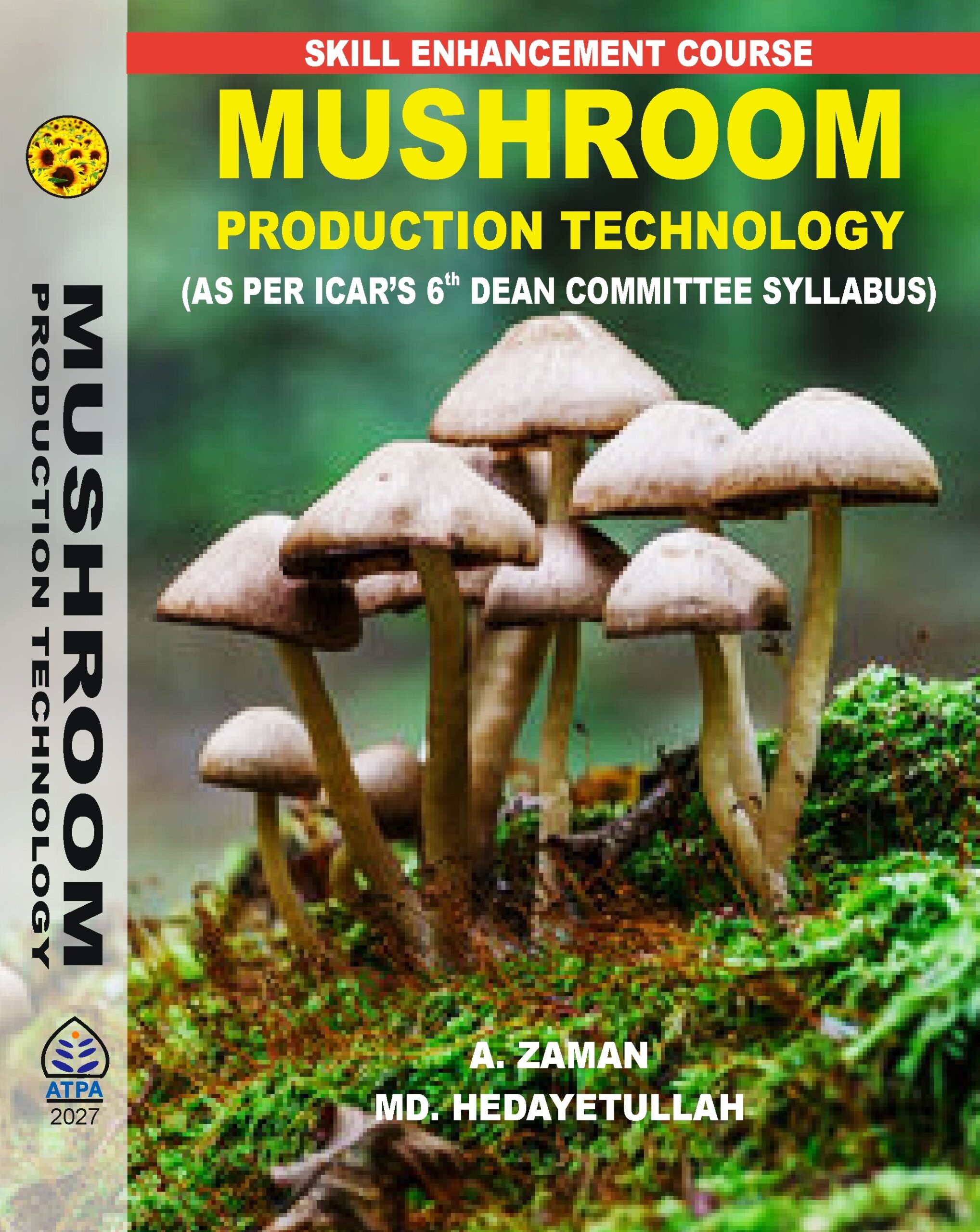
SKILL ENHANCEMENT COURSE MUSHROOM PRODUCTION TECHNOLOGY
₹1,500.00
AUTHOR: A. Zaman and Md. Hedayetullah
PUBLISHING YEAR: 2026
ISBN: 978-93-7188-739-7
@ALL RIGHT RESERVED
Description
PREFACE
This practical manual, Mushroom Production Technology (Hands-on-Training), is meticulously crafted in alignment with the visionary 6th Dean’s Committee Recommendations of the Indian Council of Agricultural Research (ICAR, 2025). It is designed to fulfill the objectives of the Skill Enhancement Course curriculum, aiming to bridge the gap between theoretical knowledge and practical, employable skills in the dynamic field of agricultural sciences.
The manual is dedicated to the subject of Mushroom Production Technology, a domain of growing importance for food security, nutritional supplementation, and sustainable agricultural entrepreneurship. It is structured to empower students, entrepreneurs, and extension professionals with a comprehensive, competency-based learning experience.
The curriculum is built upon a solid foundation of Foundational Concepts, presented through eight detailed lesson plans. These begin with Mycology and Mushroom Biology, establishing the essential scientific principles of fungi. This is followed by in-depth coverage of Substrate Preparation and Composting Techniques, the critical first step in successful cultivation. The core practices of Mushroom Cultivation and Management are then elaborated, alongside dedicated lessons on Disease Management and Post-Harvest Handling and Preservation to ensure quality and reduce losses. The course further integrates crucial lessons on Quality Control and Quality Assurance; ensuring produce meets market standards, and concludes by positioning Mushroom Production Technology as an Alternative Livelihood System, highlighting its socio-economic impact.
The heart of this manual lies in its extensive and systematic experimentation, which comprises 30 hands-on experiments. This sequence is designed to simulate the complete mushroom production cycle. It commences with fundamental laboratory skills: an Introduction to Mushroom Biology and Anatomy, Aseptic Techniques, and Laboratory Layout and Equipment Identification. Trainees then progress to core techniques like the Preparation of Culture Media (PDA), the Isolation and Sub-culturing of Mycelium, and the complete process of Spawn Production, including substrate preparation, sterilization, inoculation, and incubation.
The manual provides specialized, species-specific training with practical experiments on preparing substrates for major commercial varieties such as Oyster Mushrooms (Pleurotus species), Button Mushrooms (Agaricus bisporus), Shiitake Mushrooms (Lentinula edodes), and
Specialty Mushrooms (e.g., Reishi, Lion’s Mane). The cultivation process is detailed through experiments on Inoculation, Incubation, Inducing Fruiting (Pinning), and Managing Environmental Conditions.
Crucially, the practical curriculum extends beyond harvest to cover Harvesting Techniques, managing Multiple Flushes, and the vital post-harvest chain of Cleaning, Grading, Packaging, and Storage. To foster a holistic understanding of the mushroom enterprise, the manual includes experiments on Exploring Marketing Channels, conducting Cost Analysis, Troubleshooting Common Problems, and even exploring the preparation of Liquid Culture and Value-Added Mushroom Products. A critical experiment on Mushroom Identification is included to emphasize the importance of distinguishing between edible and poisonous species, ensuring safety.
It is our sincere hope that this hands-on training manual will serve as an indispensable guide, fostering a new generation of skilled mushroom technologists and entrepreneurs who will contribute significantly to the nation’s agricultural prosperity and nutritional well-being.
Authors
ABOUT THE BOOK
Mushroom Production Technology has been designed as a Skill Enhancement Course that equips learners with both the foundational theory and the hands-on skills required to launch or improve a commercial mushroom-growing operation. The textbook is organized in two interrelated parts. Part I (“Foundational Concepts”) presents eight core lessons that introduce the biology of fungi, outline best practices for substrate preparation and composting, explain the principles of mushroom cultivation and management, and survey disease-prevention strategies. Subsequent lessons address post-harvest handling and preservation techniques, the implementation of quality control and quality assurance systems, and the role of mushroom production as an alternative livelihood. The final theoretical lesson provides an integrative overview of the course itself, highlighting how each unit contributes to the learner’s emerging skill set.
In Part I, the journey begins with Mycology and Mushroom Biology, where students explore fungal taxonomy, life cycles and anatomy. Building on this foundation, Substrate Preparation and Composting Techniques describes how to assemble, pasteurize or compost a variety of agricultural wastes and organic materials to create an ideal growth medium. Mushroom Cultivation and Management then guides learners through spawn inoculation, climate-control requirements and harvest scheduling. Disease Management in Mushroom Cultivation teaches identification and control of common pathogens and contaminants, while Post-Harvest Handling and Preservation explains cooling, drying, packaging and storage methods that extend shelf life. Quality Control and Quality Assurance in Mushroom Production lays out sampling plans, hygiene protocols and traceability systems. The penultimate lesson positions commercial mushroom growing as a viable alternative livelihood option, exploring small-scale and community-based models. Finally, the course concludes with a meta-lesson showing how these theoretical building blocks work together as a comprehensive skill-enhancement program.
Part II (“Practical Experiments”) comprises thirty laboratory and farm exercises designed to reinforce and expand upon the theoretical lessons. Students begin by examining mushroom anatomy under the microscope and practicing aseptic technique and laboratory layout. They learn to prepare and sterilize culture media such as potato dextrose agar, isolate pure mycelial cultures, and transfer mycelium (subculture) under sterile conditions. The next set of exercises focuses on spawn production:
preparing, moistening and sterilizing grain substrates, inoculating them with mycelium, and monitoring spawn run. Once students are comfortable producing spawn, they move on to substrate formulations for oyster (Pleurotus spp.), button (Agaricus bisporus), shiitake (Lentinula edodes) and specialty mushrooms (for instance, Reishi or Lion’s Mane). They practice inoculating and incubating these substrates, identify and manage contamination, and induce fruiting bodies through pinning.
Subsequent experiments cover harvest techniques, including multiple flushes and substrate reuse; cleaning, grading, packaging and cold-chain storage; and the exploration of marketing channels and value-addition opportunities. Advanced exercises introduce liquid culture preparation, troubleshooting common cultivation problems, performing cost analyses, and comparing different cultivation systems (bags, log culture, indoor chambers, etc.). Finally, students build proficiency in mushroom identification (distinguishing edible from poisonous species) and develop simple value-added products such as dried powders, pickles and extracts.
We are extremely hopeful that by working through every theory lesson and practical exercise, learners emerge from this course with a thorough understanding of mushroom science and the real-world skills needed to launch or expand a profitable, quality-driven mushroom production enterprise.
CONTENTS
| S. No. | Chapter Name | Page |
| PREFACE | 3-4 | |
| ABOUT THE BOOK | 5-6 | |
| ABOUT THE AUTHORS | 7-9 | |
| CHPATER | ||
| PART-I | 13 | |
| Foundational Concepts (Theory) | ||
| 1 | Mycology and Mushroom Biology | 15-17 |
| 2 | Substrate Preparation and Composting Techniques | 18-20 |
| 3 | Mushroom Cultivation and Management | 21-28 |
| 4 | Disease Management in Mushroom Cultivation | 29-35 |
| 5 | Post-Harvest Handling and Preservation | 36-42 |
| 6 | Quality Control and Quality Assurance in Mushroom Production | 43-49 |
| 7 | Mushroom Production Technology as an Alternative Livelihood System | 50-51 |
| 8 | Mushroom Production Technology: A Skill Enhancement Course | 52-57 |
| Mushroom Production Technology | 58-59 | |
| Table of Content (Practical) | ||
| EXPERIMENT | ||
| PART-II | 61 | |
| S. No. | Topic | Page |
| 1 | Introduction to Mushroom Biology and Anatomy | 63-66 |
| 2 | Introduction to Aseptic Techniques | 67-70 |
| 3 | Laboratory Layout and Equipment Identification | 71-74 |
| 4 | Preparation of Culture Media (PDA – Potato Dextrose Agar) | 75-79 |
| 5 | Isolation of Mycelium from a Mushroom | 80-84 |
| 6 | Transferring Mycelium (Subculturing) | 85-88 |
| 7 | Preparation of Grain Substrate for Spawn | 89-92 |
| 8 | Sterilization of Grain Substrate | 93-96 |
| 9 | Inoculation of Grain Substrate with Mycelium (Spawn Production) | 97-98 |
| 10 | Incubation and Monitoring of Spawn Growth | 99-102 |
| 11 | Preparation of Substrate for Oyster Mushrooms (Pleurotus species) | 103-107 |
| 12 | Preparation of Substrate for Button Mushrooms (Agaricus bisporus) | 108-112 |
| 13 | Preparation of Substrate for Shiitake Mushrooms (Lentinula edodes) | 113-117 |
| 14 | Preparing Substrate for Specialty Mushrooms (& Reishi, Lion’s Mane) | 118-120 |
| 15 | Inoculation of Prepared Substrate with Spawn | 121-124 |
| 16 | Incubation of Inoculated Substrate | 125-129 |
| 17 | Identifying and Managing Contamination | 130-134 |
| 18 | Inducing Fruiting (Pinning) | 135-138 |
| 19 | Monitoring and Managing Environmental Conditions for Fruiting | 139-141 |
| 20 | Harvesting Mushrooms | 142-145 |
| 21 | Multiple Flushes and Substrate Reuse | 146-149 |
| 22 | Cleaning and Grading of Harvested Mushrooms | 150-153 |
| 23 | Packaging and Storage of Mushrooms | 154-157 |
| 24 | Exploring Marketing Channels and Strategies | 158-162 |
| 25 | Liquid Culture Preparation and Use | 163-167 |
| 26 | Troubleshooting Common Mushroom Growing Problems | 168-172 |
| 27 | Cost Analysis of Mushroom Production | 173-178 |
| 28 | Exploring Different Cultivation Systems | 179-183 |
| 29 | Mushroom Identification (Edible vs. Poisonous) | 184-187 |
| 30 | Value-Added Mushroom Products | 188-192 |
| References | 193-194 |
ABOUT THE AUTHORS
Professor (Dr.) A. Zaman, Ph D in Agronomy, is an internationally recognized scientist with 40 years of profound experience in agricultural water management. His ground-breaking and original research in fields such as irrigation water management, rainfed agriculture, cropping systems, watershed management, dry land agriculture, and biodiversity conservation has garnered global appreciation and established him as an outstanding teacher within farm universities worldwide. Dr. Zaman is credited with developing a wealth of original concepts, strategies, techniques, and tools that have profoundly contributed to agricultural science and benefited global society.
Born May 27, 1954, is a distinguished Agronomist specializing in Agricultural Water Management for enhancing crop and water productivity. His extensive career spans influential leadership roles at Bidhan Chandra Krishi Viswavidyalaya (BCKV) and Uttar Banga Krishi Viswavidyalaya (UBKV) in West Bengal, India. He has notably served as Dean, Faculty of Agriculture; Director of Research; Head of the Department of Agronomy; and Chief Scientist in AICRP on Water Management (ICAR). With significant research experience in water management, a background in post-graduate teaching, and considerable administrative acumen,
Since May 2020, Prof. Zaman has served as the Dean of the School of Agricultural Sciences at Sister Nivedita University, Kolkata. His extensive professional journey includes pivotal roles as Founder In-charge of Agriculture at The Neotia University (June 2018 to 2020), Emeritus Professor in Agriculture at M.S. Swaminathan School of Agriculture, Centurion University of Technology and Management (September 2016 – May 2018), and Programme Coordinator for the World Bank-funded West Bengal Accelerated Development of Minor Irrigation Project (September 2014 – August 2016).
Prior to these roles, Dr. Zaman gained invaluable international experience as Head of the Irrigation Expatriate Team for the Government of Uganda (1994-1996) under an ITEC Programme. In this capacity, he was instrumental in designing, laying out, and installing farmer-managed small-scale irrigation systems for sustainable crop cultivation. His vast academic contributions include authorship of 30 textbooks in agriculture, several book chapters, over 150 peer-reviewed
research papers, and 179 publications in national and international seminar and conference proceedings. Furthermore, he has significantly shaped future researchers, having guided 7 Ph.D. candidates and supervised over 50 postgraduate thesis works.
Dr. Md Hedayetullah, Assistant Professor in Agronomy, at Bidhan Chandra Krishi Viswavidyalaya, Mohanpur (West Bengal) is a dynamic and influential figure in contemporary agricultural science, bringing a distinctive blend of expertise spanning research, education, and extension policy implementation, and grassroots development.
He also leads the ICAR’s All India Coordinated Research Project (AICRP) on Chickpea, BCKV Centre. This pivotal leadership role places him at the forefront of national efforts to enhance pulse crops, driving the development of high-yielding, climate-resilient varieties and sustainable production technologies crucial for India’s nutritional security and farm profitability.
Dr. Hedayetullah earned his PhD in Agronomy from BCKV. His academic excellence was further recognized with the prestigious Maulana Azad National Fellowship, affirming his dedication to advanced scholarly inquiry and deep subject matter expertise.
His career reflects a comprehensive engagement across the agricultural ecosystem, consistently bridging the gap between scientific investigation and practical application:
As an Agronomist at the National Bank for Agriculture and Rural Development (NABARD): He gained crucial insight into agricultural finance, rural credit mechanisms, and the economic policies shaping farm performance and rural development.
As an Assistant Professor at the M.S. Swaminathan Institute of Agriculture Science: He focused intensely on sustainable development goals, conducting applied research and implementing innovative, environmentally sound farming practices.
As an Assistant Professor at the College of Agriculture, Tripura: He honed his dedication to academic instruction and mentorship, gaining a deep understanding of the challenges faced by emerging agricultural students and researchers.
A prolific author and dedicated mentor, Dr. Hedayetullah has guided 8 M.Sc. and 2 PhD students to successful completion. His extensive scholarly output includes 15 books (authored or co-authored), over 50 peer-reviewed research papers in leading national and international journals, and numerous specialized book chapters. He serves as Principal Investigator for several major externally funded research projects, underscoring his capacity to lead complex scientific initiatives. His commitment to bringing scientific knowledge directly to farmers and the public is evident through extensive engagement in live television talks and impactful farmer training programs. Blending elite academic credentials, comprehensive experience spanning agricultural finance and field research, and a clear commitment to public outreach, Dr. Hedayetullah stands as an authoritative and inspiring guide for students beginning their journey in agricultural science.
Additional information
| AUTHOR/AUTHORS | A. ZAMAN, MD. HEDAYETULLAH |
|---|---|
| PAGES | 194 |
| BINDING | Hardbond |
| PUBLICATION YEAR | 2026 |
Related products
-
-
FUNDAMENTALS OF SOIL SCIENCE
- ₹1,980.00
-