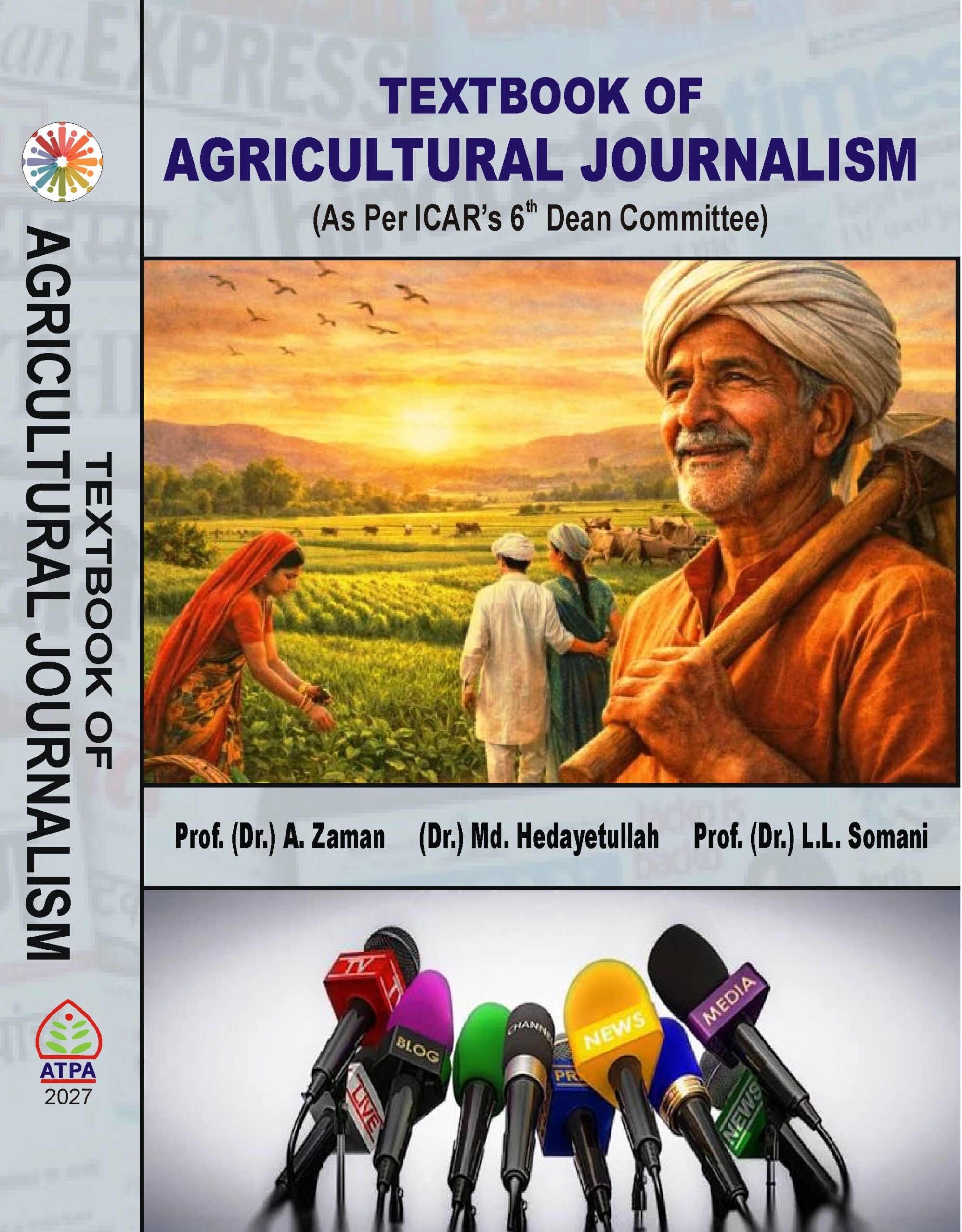
TEXTBOOK OF AGRICULTURAL JOURNALISM
₹2,500.00
AUTHOR: A. Zaman, Md. Hedayetullah and L.L. Somani
PUBLISHING YEAR: 2026
ISBN: 978-93-7188-003-9
@ALL RIGHT RESERVED
Description
PREFACE
Presently, in an age characterized by rapid technological progress and a burgeoning global population, the intersection of agricultural innovation and strategic communication has become a cornerstone of food security. Agriculture has evolved beyond traditional cultivation into a sophisticated, data-driven industry. Consequently, the success of modern farming depends heavily on the efficient transmission of knowledge from research laboratories to the field. Text Book of Agricultural Journalism is designed as a definitive guide to bridge this divide, equipping students, media professionals, and extension agents with the skills to translate complex scientific advancements into actionable information.
The textbook is organized into seven thematic chapters, beginning with an exploration of the functions and philosophy of journalism within the agricultural sector (Chapter 1). It then addresses the ethical imperatives of the profession, emphasizing the journalist’s role in influencing policy and public perception (Chapter 2), before examining the enduring significance of print media through newspapers and magazines (Chapter 3).
The middle sections of the book prioritize the evidence-based nature of the craft. Readers are provided with scholarly guidance on information synthesis, investigative research, and the intricacies of interviewing subject-matter experts (Chapter 4). The curriculum then transitions into the artistry of storytelling (Chapter 5) and the strategic use of visual media, including photography and data visualization, to enhance accessibility and impact (Chapter 6). The text concludes by grounding these creative efforts in the technical realities of editorial production, copy editing, and publication design (Chapter 7). The chapters are independently delved with relevant lessons for the students of all students at graduate levels across the disciplines of agricultural sciences.
By harmonizing theoretical depth with hands-on methodology, this volume serves as both an academic resource and a professional field manual. It is my sincere hope that this work empowers a new generation of communicators to not merely document the agricultural landscape, but to serve as essential conduits for building sustainable, resilient, and informed food systems across the globe revolutionize the agricultural communication system.
Authors
SYLLABUS
THEORY
Journalism – Meaning, nature, importance, and types of journalism. Agricultural Journalism – Meaning, definition, principle, objectives, types, and scope. Similarities and difference between agricultural journalism and other types of journalism; Role of agricultural journalist, Training of agricultural journalist; Qualities of journalist, Role of journalist /journalism in agricultural development and development of newspaper and magazines readers; Newspaper and magazines as communication media: Characteristics, kinds and functions of newspaper and magazines, Characteristics of newspaper and magazines readers. Form, content, style and language of newspaper and magazines, Standard part of newspaper and magazines; The agricultural story: Types of Agriculture stories, subject matter of the agricultural story, structure of the agricultural story.
Gathering farm information -Sources of farm information: abstracting from research and scientific materials, interviews, coverage of events. Other sources: electronic media, field study. Success stories definition, nature, components, guidelines of writing a success story; Writing a news story difference between news and feature story, the principle of writing a news story, Inverted pyramid structure.
Organizing the material, treatment of the story, writing the news lead and the body; Readability measure-readability ease score, automated readability index, gunning fog index; How to improve readability of articles and stories; Use of photograph in agricultural journalism- Basic principles of photography – composition, exposure, lens, light. Use of artwork (Graphs, charts maps, etc.); Writing the captions; Editorial mechanism: Copy reading, headline and title writing; Proof reading: definition, signs and symbols of proofreading, level of proofreading, duties of a proof-reader; Layout – meaning, principles of layout and design.
ABOUT THE BOOK
Text Book of Agricultural Journalism serves as a comprehensive resource designed to bridge the gap between technical agricultural knowledge and effective public communication. In an era where food security and sustainable farming are global priorities, this text provides the essential framework for journalists to translate complex scientific data into accessible, actionable information for farmers and the public.
The book is structured into seven thematic chapters that follow a logical progression, starting from the theoretical foundations of journalism. It defines the unique role of an agricultural journalist—not merely as a reporter, but as a development catalyst. By examining professional ethics and the societal impact of agricultural media, the text emphasizes the responsibility inherent in informing the rural and urban sectors alike.
Moving from theory to application, the book delves into the craft of media production. Readers learn how to gather information through scientific abstracting and field interviews, and how to master the art of storytelling—specifically through news and feature writing. A significant portion of the text is dedicated to readability and visual communication, recognizing that the efficacy of a message depends on its presentation. By covering technical aspects such as photo composition, data visualization, and editorial copy-editing, the book ensures that journalists can produce content that is both readable and visually compelling.
The inclusion of an extensive “Practical” section transforms the volume into a hands-on manual. Through 14 structured exercises—ranging from proofreading and headline writing to layout design and event coverage—students are given the tools to transition from academic study to professional practice. This dual focus on theoretical depth and technical rigor makes Text Book of Agricultural Journalism an indispensable guide for students, extension workers, and communication professionals striving to advance the agricultural sector through informed and ethical media practices.
CONTENT
| S. No. | Topic/Content | Page |
| Preface | 3 | |
| Syllabus | 4 | |
| About The Authors | 5-7 | |
| About The Book | 8 | |
| Lesson Plan | 11-12 | |
| LESSON | ||
| Chapter 1: Foundations of Journalism and Agricultural Communication | ||
| 1 | Journalism – Meaning, Nature, Importance, and Types of Modern Journalism | 13-23 |
| 2 | Agricultural Journalism– Meaning, Definition, Principle, Objectives, Types, and Scope | 24-35 |
| 3 | Similarities and Difference between Agricultural Journalism and Other Types of Journalism | 36-45 |
| 4 | Role of Agricultural Journalist | 46-54 |
| 5 | Training of Agricultural Journalists in the 21st Century | 55-66 |
| Chapter 2: Professional Ethics and Development Impact | ||
| 6 | Qualities of a Journalist an Effective and Ethical Journalist | 67-75 |
| 7 | Role of Journalist /Journalism in Agricultural Development | 76-86 |
| 8 | Development of Newspaper and Magazine Readers | 87-97 |
| Chapter 3: Media Platforms: Newspapers and Magazines | ||
| 9 | Function of Newspapers and Magazines as Communication Media | 98-106 |
| 10 | Characteristics, Kinds, and Functions of Newspapers and Magazines | 107-116 |
| 11 | Characteristics of Newspaper and Magazine Readers | 117-128 |
| 12 | Form, Content, Style, and Language of Newspapers and Magazines | 129-137 |
| 13 | Standard Parts of Newspapers and Magazine | 138-148 |
| Chapter 4: Gathering and Sourcing Information | ||
| 14 | Agricultural Story: Types of Agriculture Stories, Subject Matter of the Agricultural Story, Structure of the Agricultural Story | 149-163 |
| 15 | Gathering Farm Information -Sources of Farm Information for Sustainable Agricultural Decision-Making | 164-176 |
| 16 | Abstracting from Research and Scientific Materials, Interviews, Coverage of Events | 177-186 |
| 17 | Roles of Electronic Media and Field Study as Sources | 187-195 |
Chapter 5: Writing Techniques and Storytelling |
||
| 18 | Success Stories-Definition, Nature, Components, Guidelines of Writing a Success Story | 196-204 |
| 19 | Writing a News Story and Difference between News and Feature Story | 205-213 |
| 20 | Principle of Writing a News Story | 214-218 |
| 21 | Inverted Pyramid Structure | 219-234 |
| 22 | Organizing the Materials, Treatment of the Story, Writing the News Lead and the Body | 235-245 |
Chapter 6: Readability and Visual Communication |
||
| 23 | Readability Measure-Readability Ease Score, Automated Readability Index, Gunning Fog Index | 246-257 |
| 24 | How to Improve Readability of Articles and Stories | 258-269 |
| 25 | Effective Use of Photograph in Agricultural Journalism | 270-280 |
| 26 | Basic Principles of Photography – Composition, Exposure, Lens, Light | 281-288 |
| 27 | Effective Use of Artwork: Graphs, Charts and Maps in Artwork and Education | 289-293 |
| 28 | Writing Effective Captions for Visual Media | 294-302 |
Chapter 7: Editorial Mechanisms, Proofreading, and Design |
||
| 29 | Editorial Mechanism: Copy Reading, Headline and Title Writing | 303-310 |
| 30 | Proofreading: Definition, Signs and Symbols of Proofreading | 311-324 |
| 31 | Level of Proofreading, Duties of a Proof-Reader | 325-336 |
| 32 | Delineating the Meaning, Principles of Layout, and Foundational Elements of Design | 337-344 |
| References | 345-352 | |
ABOUT THE AUTHORS
Professor (Dr.) A. Zaman, Ph D in Agronomy, is an internationally recognized scientist with 40 years of profound experience in agricultural water management. His ground-breaking and original research in fields such as irrigation water management, rainfed agriculture, cropping systems, watershed management, dry land agriculture, and biodiversity conservation has garnered global appreciation and established him as an outstanding teacher within farm universities worldwide. Dr. Zaman is credited with developing a wealth of original concepts, strategies, techniques, and tools that have profoundly contributed to agricultural science and benefited global society.
Born May 27, 1954, is a distinguished Agronomist specializing in Agricultural Water Management for enhancing crop and water productivity. His extensive career spans influential leadership roles at Bidhan Chandra Krishi Viswavidyalaya (BCKV) and Uttar Banga Krishi Viswavidyalaya (UBKV) in West Bengal, India. He has notably served as Dean, Faculty of Agriculture; Director of Research; Head of the Department of Agronomy; and Chief Scientist in AICRP on Water Management (ICAR). With significant research experience in water management, a background in post-graduate teaching, and considerable administrative acumen, Since May 2020, Prof. Zaman has served as the Dean of the School of Agricultural Sciences at Sister Nivedita University, Kolkata. His extensive professional journey includes pivotal roles as Founder In-charge of Agriculture at The Neotia University (June 2018 to 2020), Emeritus Professor in Agriculture at M.S. Swaminathan School of Agriculture, Centurion University of Technology and Management (September 2016 – May 2018), and Programme Coordinator for the World Bank-funded West Bengal Accelerated Development of Minor Irrigation Project (September 2014 – August 2016).
Prior to these roles, Dr. Zaman gained invaluable international experience as Head of the Irrigation Expatriate Team for the Government of Uganda (1994-1996) under an ITEC Programme. In this capacity, he was instrumental in designing, laying out, and installing farmer-managed small-scale irrigation systems for sustainable crop cultivation. His vast academic contributions include authorship of 30 textbooks in agriculture, several book chapters, over 150 peer-reviewed research papers, and 179 publications in national and international seminar and conference proceedings. Furthermore, he has significantly shaped future researchers, having guided 7 Ph.D. candidates and supervised over 50 postgraduate thesis works.
Dr. Md Hedayetullah, Assistant Professor in Agronomy, at Bidhan Chandra Krishi Viswavidyalaya, Mohanpur (West Bengal) is a dynamic and influential figure in contemporary agricultural science, bringing a distinctive blend of expertise spanning research, education, and extension policy implementation, and grassroots development.
He also leads the ICAR’s All India Coordinated Research Project (AICRP) on Chickpea, BCKV Centre. This pivotal leadership role places him at the forefront of national efforts to enhance pulse crops, driving the development of high-yielding, climate-resilient varieties and sustainable production technologies crucial for India’s nutritional security and farm profitability.
Dr. Hedayetullah earned his PhD in Agronomy from BCKV. His academic excellence was further recognized with the prestigious Maulana Azad National Fellowship, affirming his dedication to advanced scholarly inquiry and deep subject matter expertise.
His career reflects a comprehensive engagement across the agricultural ecosystem, consistently bridging the gap between scientific investigation and practical application:
As an Agronomist at the National Bank for Agriculture and Rural Development (NABARD): He gained crucial insight into agricultural finance, rural credit mechanisms, and the economic policies shaping farm performance and rural development.
As an Assistant Professor at the M.S. Swaminathan Institute of Agriculture Science: He focused intensely on sustainable development goals, conducting applied research and implementing innovative, environmentally sound farming practices.
As an Assistant Professor at the College of Agriculture, Tripura: He honed his dedication to academic instruction and mentorship, gaining a deep understanding of the challenges faced by emerging agricultural students and researchers.
A prolific author and dedicated mentor, Dr. Hedayetullah has guided 8 M.Sc. and 2 PhD students to successful completion. His extensive scholarly output includes 15 books (authored or co-authored), over 50 peer-reviewed research papers in leading national and international journals, and numerous specialized book chapters. He serves as Principal Investigator for several major externally funded research projects, underscoring his capacity to lead complex scientific initiatives. His commitment to bringing scientific knowledge directly to farmers and the public is evident through extensive engagement in live television talks and impactful farmer training programs. Blending elite academic credentials, comprehensive experience spanning agricultural finance and field research, and a clear commitment to public outreach, Dr. Hedayetullah stands as an authoritative and inspiring guide for students beginning their journey in agricultural science.
Dr. L.L. Somani, Retired Director Resident Instructions, MPUAT, Udaipur. He has worked as Extension Subject Matter Specialist for several years interacting with the problems of farming community and demonstrated field solurions to their problems. Beside Being Ph.D. in Soil Science He has Earned Diploma in Farm & Science Journalism. Dr Somani also holds PG in Journalism from Rajasthan University. He was a Post-Doctoral Fellow at Waite Agricultural Institute, Adelaide, AUSTRALIA (1975-77). Prof. Somani has many papers published in national and International Journals/Symposia, etc. and many number of books to his credit in different disciplines of Agriculture. He held different position in MPUAT and has spreaded highly innovative ideas and programmes for the development of Agriculture.
Additional information
| AUTHOR/AUTHORS | A. ZAMAN, L.L. Somani, MD. HEDAYETULLAH |
|---|---|
| PAGES | 352 |
| BINDING | Hardbond |
| PUBLICATION YEAR | 2026 |
Related products
-
-
TEXTBOOK OF LANDSCAPING
- ₹2,980.00
-
-
-
PRODUCTION TECHNOLOGY FOR SPICES
- ₹980.00
-