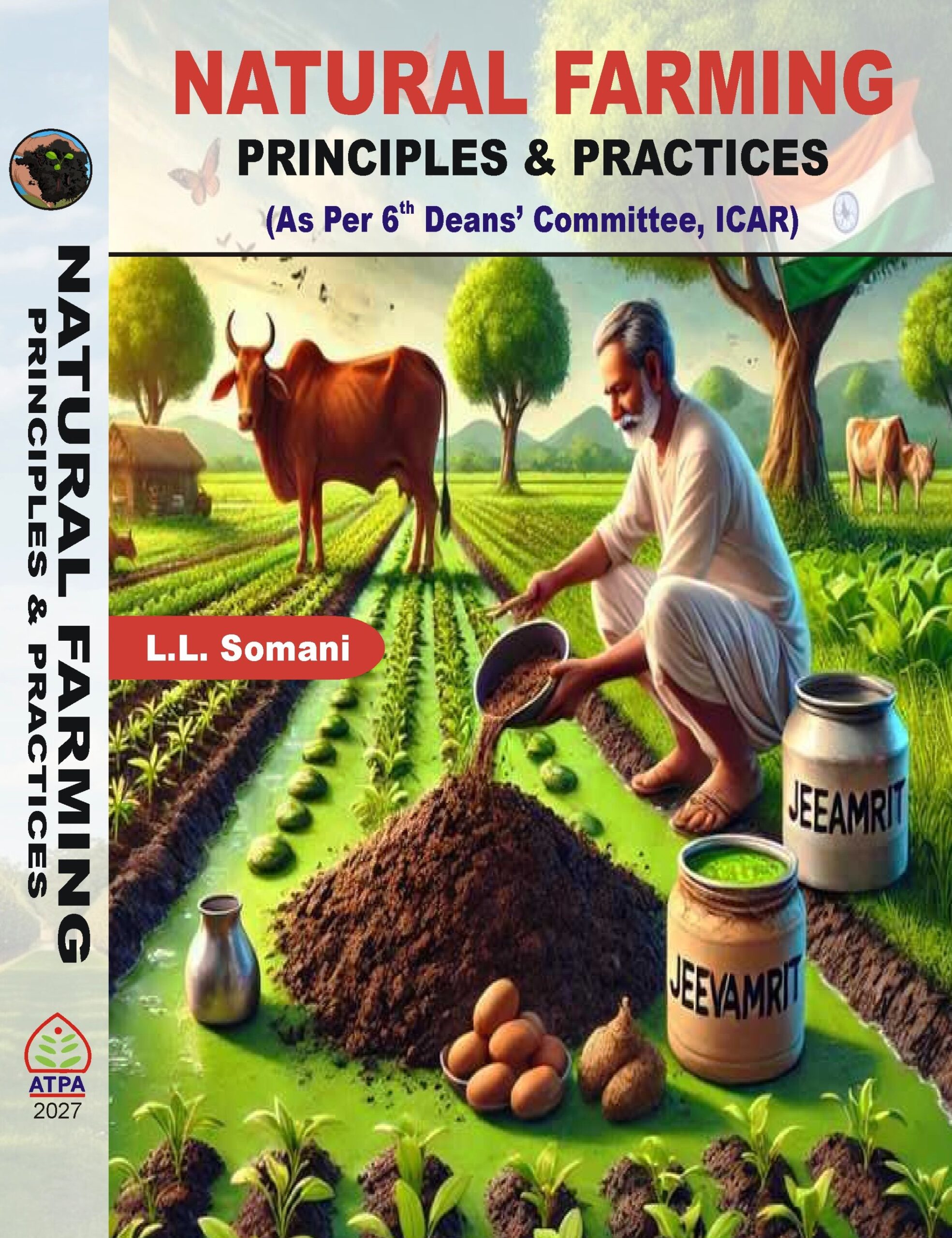
NATURAL FARMING: PRINCIPLES & PRACTICES
₹1,980.00
AUTHOR: L.L. SOMANI
PUBLISHING YEAR: 2026
ISBN: 978-93-7188-007-7
@ALL RIGHT RESERVED
Description
PREFACE
Natural Farming or Zero Budget Natural Farming (ZBNF) has become a pivot point of discussion among the agricultural scientists, government, farmers and several other informal groups engaged in agriculture. This is mainly due to the reason that there are two diametrically opposite school of thoughts on this topic co-existing in the country. There are scientists who straightaway discard the philosophy of Natural Farming. On the other hand, its proponents are claiming the method to be panacea for all problems causing distress in Indian agriculture, especially for smallholders.
Amidst a growing concern for our environment, climate change, and the urgent need for sustainable development, the spotlight on natural farming has never been brighter. This comprehensive volume aims to be a cornerstone in the discourse on agriculture and sustainability, shedding light on the intricate tapestry of natural farming.
This book’s inception arises from a keen recognition of the pressing need to address the evolving landscape of agriculture. Natural farming, with its emphasis on harmony with nature, regenerative practices, and minimal environmental impact, emerges as a beacon of hope in navigating the complexities of our time. Standing at the intersection of environmental degradation and the imperative for food safety, natural farming presents itself as a viable and sustainable alternative.
Natural farming, heralded as a beacon of regenerative agriculture worldwide, advocates for the cultivation of safe, premium crops while nurturing a symbiotic relationship with the environment. It champions techniques minimizing chemical intervention, such as the consistent use of cow dung and urine-based blends, efficient recycling of crop residues, intercropping with legumes for robust soil coverage, pre-monsoon dry sowing, judicious irrigation, and targeted watering at noon to harmonize soil-air-moisture equilibrium. By placing soil and ecosystem well-being at the forefront, this approach aims to slash input expenses while amplifying farm vigor and crop yields. Moreover, it endeavours to fortify agroecosystems against the onslaught of climate change.
Natural Farming offers an alternative that emphasizes minimal use of external inputs and focuses on regenerating soil health, conserving water, and promoting biodiversity, hence reducing the cultivation cost and enhancing overall profitability. Techniques such as mulching, crop rotation, intercropping, and the use of natural fertilizers (like cow dung and urine-based bio-formulations) are central to this method. These practices not only sustain productivity but also foster resilience against pests and environmental stress.
This book will serves as a comprehensive resource for understanding the principles, practices, and advancements in natural farming. Structured to provide a holistic view, it encompasses the current status of natural farming methods, their impact on agricultural ecosystems, and the potential they hold for the future of global food production.
The text critically examines various schools and methodologies of natural farming, the design and functional characteristics of natural farms, and the integration of crops, trees, and livestock for ecological balance. Core topics include nutrient cycling, pest and disease management, ecological engineering, footprint assessments (ecological, water, carbon, nitrogen), and ecosystem service evaluation. Additionally, the book addresses certification standards, value addition, market potential, and policy interventions, supple- mented with case studies and models of successful implementation
It is hoped that “Natural Farming ” inspires and guide individuals and institutions towards embracing and championing natural farming for the betterment of our planet and the well-being of future generations.
We hope the book will answer some of the critical questions pertaining to Natural Farming. However, at the same time, it also opens new vistas for research with many key researchable questions which need to be systematically investigated to understand the causality and long-term impact of Natural Farming.
I am confident that “Natural Farming: Principles and Practices” will be an indispensable resource for the students and learning community, contributing to the advancement of sustainable agriculture.
Author
ABOUT THE BOOK
This book provides a scientific and systematic exposition of natural farming, grounded in the Indian heritage of ancient agricultural practices and extending to contemporary ecological frameworks. It elucidates the historical evolution, fundamental principles, objectives, and scope of natural farming, highlighting its relevance in mitigating climate change, enhancing soil health, optimizing water use, promoting carbon sequestration, conserving biodiversity, and ensuring food and nutritional security in alignment with the Sustainable Development Goals (SDGs). The text critically examines various schools and methodologies of natural farming, the design and functional characteristics of natural farms, and the integration of crops, trees, and livestock for ecological balance. Core topics include nutrient cycling, pest and disease management, ecological engineering, footprint assessments (ecological, water, carbon, nitrogen), and ecosystem service evaluation. Additionally, the book addresses certification standards, value addition, market potential, and policy interventions, supplemented with case studies and models of successful implementation. It is intended for researchers, students, extension professionals, and policy planners engaged in sustainable agriculture.
This book aims to document traditional natural farming practices across India, their scientific background, production methods, benefits to soil health, crop-specific practices, waste recycling techniques, soil fertility enhancement, and natural pest management. Such documentation facilitates soil quality assessment, carbon footprint analysis, and economic evaluation of agroecosystem services, aiding policy decisions at local and national levels. The book serves as a valuable resource for student, teachers, researchers, and extension personnel involved in natural farming education.
In this context, this book stands as a paramount scientific compilation on natural farming. It serves as a comprehensive resource for educators, researchers, and extension workers striving to improve agroecosystems and human health. By covering the principles and success stories of natural farming, this book is invaluable to farmers and entrepreneurs transitioning to this sustainable approach.
SYLLABUS
Principles and Practices of Natural Farming 2 (1+1)
- Indian Heritage of Ancient Agriculture, History of Natural Farming,
- Importance of natural farming in view of climate change, soil health, water use carbon sequestration, biodiversity conservation, food security and nutritional security, and sustainable development goals (SDGs),
- Concept of natural farming; Definition of natural farming; Objective of natural farming,
- Essential characteristics and Principles of natural farming
- Scope and importance of natural farming
- Main Pillars of natural farming
- Methods/ types/schools of natural farming
- Characteristics and design of a natural farm, Concept of ecological balance, ecological engineering and community responsibility in natural versus other farming systems
- Introduction to concept of ecological, water, carbon and nitrogen foot prints,
- Concept and evaluation of ecosystem services, integration of crops, trees and animals, cropping system approaches, Biodiversity, indigenous seed production, farm waste recycling, water conservation and renewable energy use approaches on a natural farm,
- Rearing practices for animals under natural farming,
- Nutrient management in natural farming and their sources,
- Insect, pest, disease and weed management under natural farming; Mechanization in natural farming,
- Processing, labelling, economic considerations and viability, certification and standards in natural farming, marketing and export potential of natural farming produce and products
- Initiatives taken by Government (central/state), NGOs and other organizations for promotion of natural farming and chemical free agriculture,
- Case studies and success stories in natural farming and chemical free traditional farming,
- Entrepreneurship opportunities in natural farming
CONTENTS
| NO | TITLES | PAGE |
| Preface | 3-4 | |
| About The Book | 5 | |
| Syllabus | 6 | |
| About The Author | 8 | |
| CHAPTERS | ||
| 1 | Indian Heritage & History of Natural Farming | 9-12 |
| 2 | Importance of Natural Farming | 13-24 |
| 3 | Concept, Definition and Objective of Natural Farming | 25-29 |
| 4 | Natural Farming Vs. Organic Farming Vs. Conventional Farming | 30-31 |
| 5 | Principles & Practices of Natural Farming | 32-38 |
| 6 | Scope of Natural Farming | 39-44 |
| 7 | Main Pillars of Natural Farming | 45-58 |
| 8 | Methods/ Types/ Schools of Natural Farming | 59-65 |
| 9 | Characteristics and Design of A Natural Farm | 66-69 |
| 10 | Agro Ecosystem Services & Carbon & Nitrogen Foot Print in Natural Farming | 70-78 |
| 11 | Agro-Ecology & Soil Properties Influencing Plant Growth | 79-86 |
| 12 | Indegenous Seed in Natural Farming | 87-91 |
| 13 | Integrated Farming System Approach Under N.F. | 92-100 |
| 14 | Farm Waste Recycling in Natural Farming | 101-103 |
| 15 | Water Conservation & Water Management | 104-112 |
| 16 | Renewable Energy Technologies in Natural Farming | 113-116 |
| 17 | Rearing Practices For Animals Under Natural Farming | 117-120 |
| 18 | Nutrient Management In Natural Farming | 121-129 |
| 19 | Insect-Pest and Disease Management | 130-159 |
| 20 | Weed Management In Natural Farming | 160-170 |
| 21 | Mechanisation Under Natural Farming | 171-175 |
| 22 | Processing & Labelling | 176-180 |
| 23 | Certification & Branding | 181-192 |
| 24 | Marketing & Export of Natural Farming Produce | 193-204 |
| 25 | Government Incentives for Promotion of Natural Farming | 205-214 |
| 26 | Success Stories | 215-220 |
| 27 | Entrepreneurship/ Business Opportunities in Natural Farming | 221-227 |
| LITERATURE CITED | 228-230 | |
| FAQ on Natural Farming | 231-232 | |
Additional information
| AUTHOR/AUTHORS | L.L. Somani |
|---|---|
| PAGES | 232 |
| BINDING | Hardbond |
| PUBLICATION YEAR | 2026 |
Related products
-
-
FUNDAMENTALS OF FRUIT SCIENCE
- ₹1,980.00
-