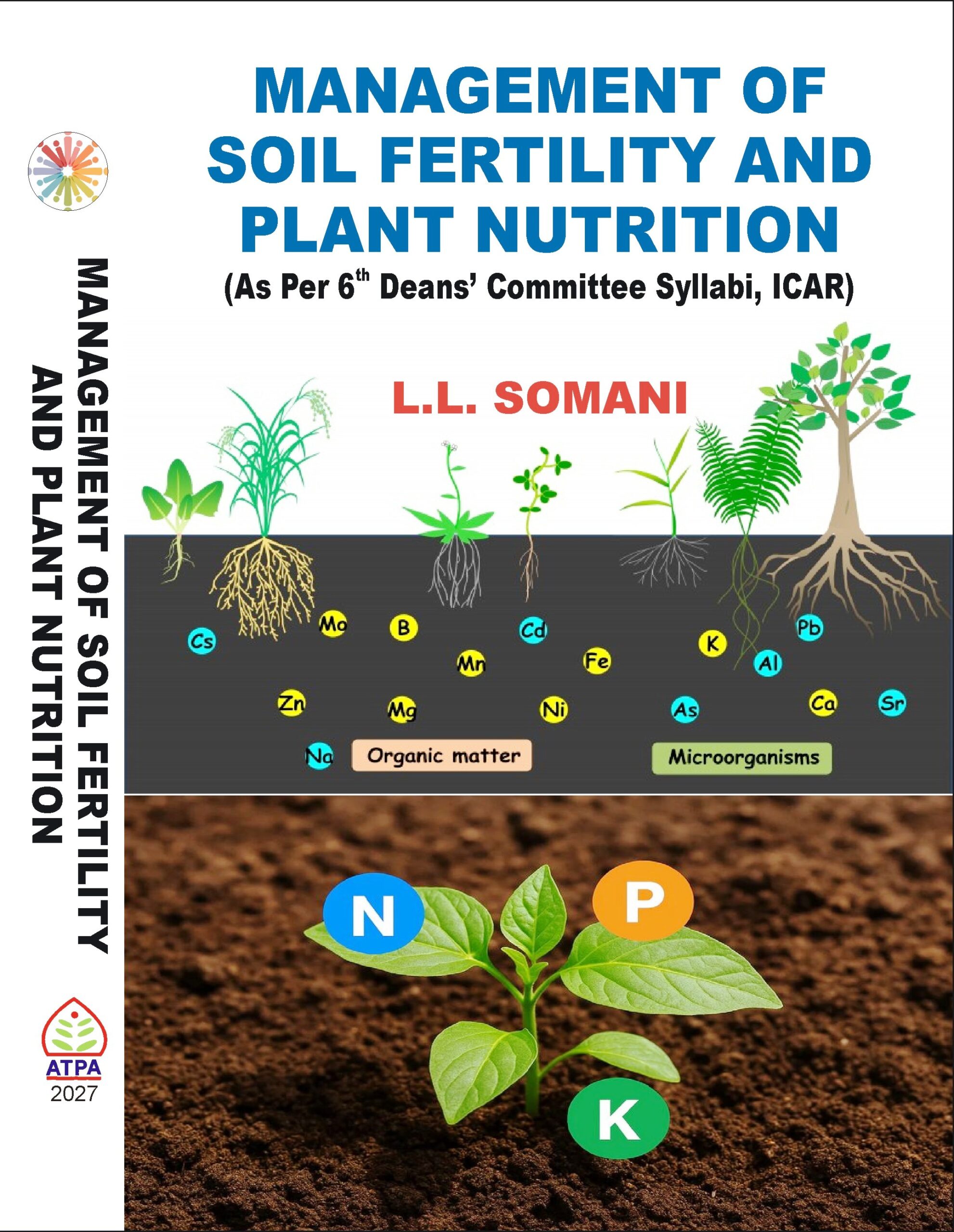
MANAGEMENT OF SOIL FERTILITY AND PLANT NUTRITION
₹1,980.00
AUTHOR: L.L. SOMANI
PUBLISHING YEAR: 2026
ISBN: 978-93-7188-544-7
@ALL RIGHT RESERVED
Description
PREFACE
Soil is composed mainly of mineral particles, organic matter, organisms, air pores and water all of which relate to one another and with plants and microbes to form an ecosystem. The soil, as the upper layer of the earth’s surface, supports the entire human race for food, fibre, water, building materials construction sites and waste disposal.
Soil science deals with the systematic study of soils as non-renewable (or very slowly renewable) resources which should be judiciously managed so that it could serve our generation and future generations. This book Principles of Soil Science deals with important concepts basic to the understanding of soil, its composition and the various uses the soil could be put.
Principles of soil science provides a current and comprehensive introduction to soil science for students in the fields of environmental and agricultural science, ecology, geology, soil and land management, natural resources management and environmental engineering.
The aim of this book is to make students understand the nature and uses of soil in natural and modified environments. The book provides information on soils as natural units of entities with their inherent characteristics, provides an understanding of significance fundamental soil properties, and provides information on basic soil-plant relationships and the available soil management practices.
A good agronomist must be knowledgeable about the soil in which crops are grown while a good soil scientist must be well groomed in the agronomy of crops. “Principles of soil science” adequately meets the needs of these two groups of scientists and more.
The course-principles of soil science – is meant to provide essential information for those who want to acquire knowledge about soils and how to use and manage them. Going through this book would afford the student to become familiar with soils as natural units or entities and with their inherent characteristics.
Second, it will develop in the student an understanding of the significance of fundamental soil properties; third, to set forth basic relationships between soils and plants; and fourthly to give the student an understanding of the principles involved in the use of proved soil management practices. General principles of soil science are emphasized and explained in unambiguous terms while most of the technical detailed are retained for students pursuing soil science at higher levels.
This book is essential for students in university on Bachelor of Agriculture and technology programmes, agronomists, foresters, farmers and other users of soils. Principles of soil science course are principally meant for the lower levels of Bachelor of Agricultural programmes in the University, but equally useful as a reference source for other scholars and soil user. It covers those topics of soil science which directly and critically affect nutrition and growth of field crops.
The book begins with some fundamental soil concepts such as the definition of soil, origin and development of soils, uses of soils in general and soil forming factors.
Later chapters deal with soil physical properties and interactions, soil types and their implication to agriculture, Subsequent modules deal with components of soil fertility including factors controlling soil fertility such as soil organic matter, soil reaction, soil aeration soil colloids and cation exchange capacity, essential soil nutrients for crop growth, fertilizer and manures including their management. Students are also taken through some fundamental principles of soil and plant analysis as diagnostic tool for detecting nutrient sufficiency and deficiency on field crops. The book also contains some briefs on improvement and maintenance of soil fertility to sustain present crop yield and preserve the soil for future use.
L.L. Somani
ABOUT THE BOOK
The aim of this book is to make students understand the nature and uses of soil in natural and modified environments. The book provides information on soils as natural units of entities with their inherent characteristics, provides an understanding of significance fundamental soil properties, and provides information on basic soil-plant relationships and the available soil management practices as prescribed by the 6th deans’ committee of ICAR. The book incorporates briefs on improvement and maintenance of soil fertility to sustain present crop yield and preserve the soil for future use.
CONTENTS
| S.No. | TITLE | Page No. |
| Preface | 3-4 | |
| About the Authors | 6 | |
| About the Book | 6 | |
| CHAPTERS | ||
| 1 | Soil and Its Componants | 7-14 |
| 2 | Soil Morphologivcal, Physical, Chemical & Biological Properties | 15-21 |
| 3 | Soil Microorganisms | 22-29 |
| 4 | Rhizosphere & Its Domain | 30-46 |
| 5 | Acid, Saline & Alkali Soils and their Reclamation | 47-56 |
| 6 | Soil Fertility, Productivity and Crop Nutrition | 57-75 |
| 7 | Nutrient Sources: Organic Manures & Biofertilisers | 76-94 |
| 8 | Nutrient Sources: Chemical Fertilisers | 95-101 |
| 9 | Methods of Fertilizer Applicaton | 102-124 |
| 10 | Integrated Nutrient Management | 125-135 |
| 11 | Soil Quality and Soil Health | 136-148 |
| 12 | Best Management Practices | 149-165 |
| 13 | Some Promising Traditional Manures | 166-175 |
| 14 | Soil Amendments | 176-183 |
| 15 | Fertiliser Storage | 184-191 |
| 16 | Nutrient Use Efficiency | 192-199 |
| 17 | Carbon Sequestration & Carbon Trading | 200-203 |
| 18 | Soil Test Crop Response (STCR) Approach for Fertiliser Recommendation | 204-207 |
| 19 | Site Specific Nutrient Management (SSNM) | 208-212 |
ABOUT THE AUTHOR
Prof. Dr. L.L. Somani is retired Director Resident Instructions MPUAT, Udaipur. He has authored several books like Handbook of Biofertilisers, Biodynamic Organic Farming, Composting Technology, Vermicomposting & Vermiwash, and Handbook on Green Manuring, Green Manuring for Sustainable Agriculture, Organic Recycling and Bioinoculants, efficient use of fertilisers, soil conditioners and Amendments, handbook of biofertlisers, Introduction to Agronomy and Horticulture, Diagnosis and Improvement of Acid Soils, Management of Salt Affected Soils and Water, Textbook Series: Problematic Soils and Their Management, Soil Fertlility and Plant Nutrition, Textbook Series: Fundamentals of Agronomy, Nature, Properties and Management of Saline and alkali Soils, Alkali Soils: Their Reclamation and Management, etc.
Additional information
| AUTHOR/AUTHORS | L.L. Somani |
|---|---|
| PAGES | 212 |
| BINDING | Hardbond |
| PUBLICATION YEAR | 2026 |
Related products
-
-
TEXTBOOK OF SOIL AND WATER CONSERVATION
- ₹2,500.00
-