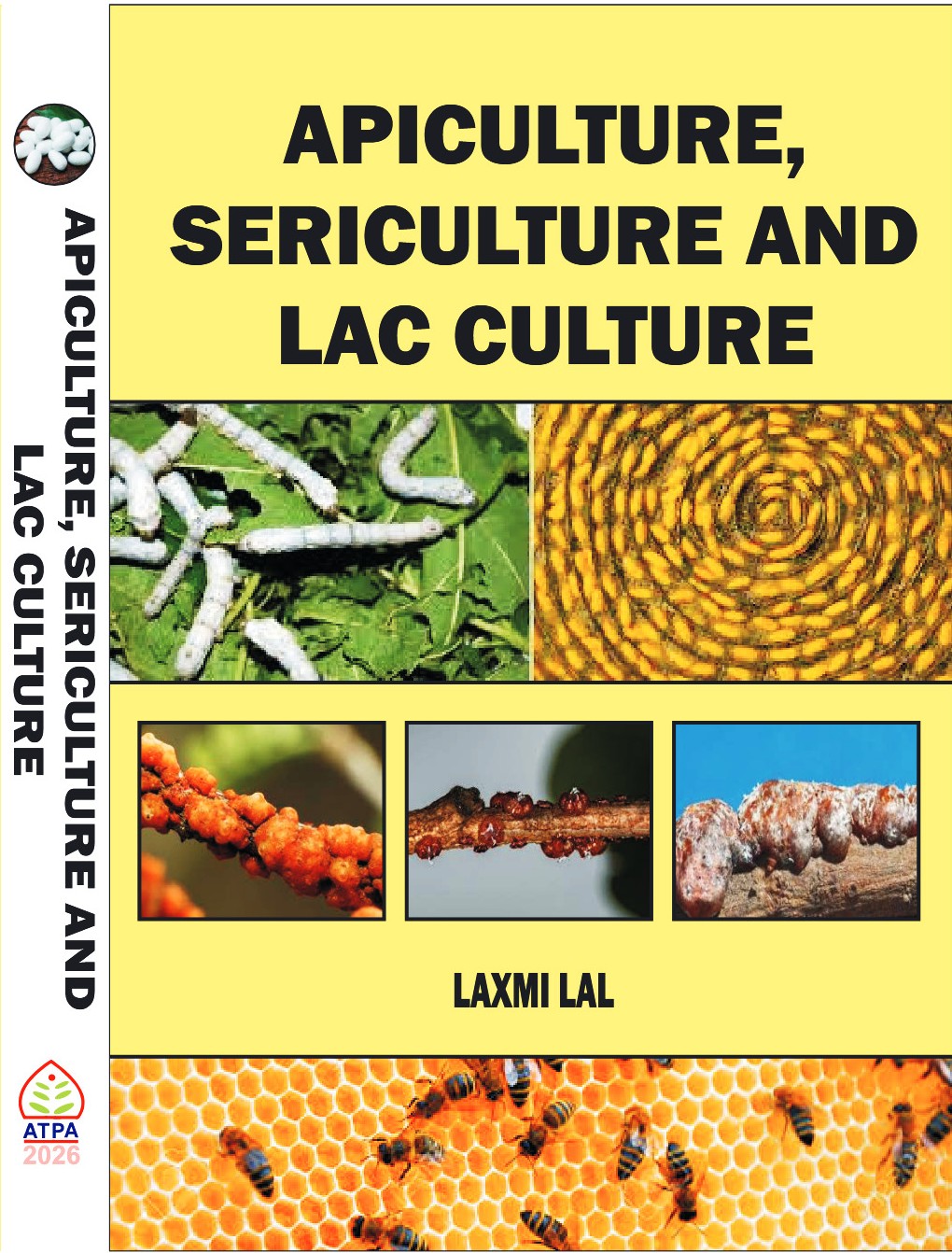
APICULTURE SERICULTURE AND LAC CULTURE
₹1,500.00
AUTHOR: LAXMI LAL SOMANI
PUBLISHING YEAR: 2026
ISBN: 9789371882668
@ALL RIGHT RESERVED
Description
ABOUT THE BOOK
Any of the numerous species of insects that carry out advantageous tasks like pollination and pest control are referred to as beneficial insects. The term “pest” is used to describe insects that hinder production when the goal is to develop a particular crop, while the terms “useful” or “beneficial” are used to describe insects that aid production. Beneficial insects deal with the usefulness of the science of entomology for the benefit of mankind. It covers the study of insects which are beneficial to human beings. It deals with the ways in which beneficial insects like predators, parasitoids, pollinators or productive insects like honey bees, silkworm and lac insect can be best exploited for our welfare.
Bees also generate wax, which is a valuable commodity. The silkworms, which spin a continuous strand of silk while they are within their cocoons as a result of glandular secretion, are the source of the pure natural silk used in man’s clothing.
The kusum, ber, and palas trees are only a few of the forest trees that are home to the lac bug type of insect. From its body surface, it secretes a resinous fluid that hardens to produce a dome-shaped hard covering for the insect living inside.
The present text highlights the skill and need in the lac cultivation which will be helpful to get a superficial idea about the lac culture. It will not only help in understanding the life stages of lac insect during lac cultivation but will also provide an opportunity to increase the plant population of suitable lac host to enhance lac cultivation as well as lac productivity in the country. Lac cultivation is the need of the day in order to preserve environmental biodiversity.
This book is intended for graduate students of agriculture, horticulture and allied fields in providing essential elementary knowledge about all these beneficial insects.
CONTENTS
| NO.
|
TOPIC | ||
| PREFACE | 3 | ||
| SYLLABUS | 4 | ||
| ABOUT THE BOOK | 7 | ||
| ABOUT THE AUTHORS | 8 | ||
| CHAPTERS | |||
| 01 | IMPORTANCE OF BENEFICIAL INSECTS IN AGRICULTURE, | 9-16 | |
| 02 | HISTORY OF APICULTURE, MORPHOLOGY AND ANATOMY, BEE CONSERVATION | 17-33 | |
| 03 | BEE REARING, EQUIPMENT USED, SEASONAL MANAGEMENT | 34-49 | |
| 04 | BEE HIVES, BEE PASTURAGE, BEE FORAGING, AND COMMUNICATION | 50-55 | |
| 05 | MANAGEMENT OF INSECTS PESTS & DISEASES OF HONEY BEES | 56-61 | |
| 06 | HISTORY, DEVELOPMENT VOLTINISM AND BIOLOGY OF SILKWORM | 62-85 | |
| 07 | MULBERRY CULTIVATION, PRESERVATION OF MULBERRY LEAVES | 86-95 | |
| 08 | REARING OF MULBERRY SILKWORM | 96-107 | |
| 09 | SILKWORM REARING, MOUNTING, HARVESTING AND MARKETING OF COCOONS | 108-120 | |
| 10 | SILKWORM: CARE & HANDLING | 121-125 | |
| 11 | PEST AND DISEASES OF SILKWORM AND THEIR MANAGEMENT | 126-137 | |
| 12 | CONSTRAINTS AND OPPORTUNITY | 138-147 | |
| 13 | LAC CULTURE, MORPHOLOGY, BIOLOGY, BEHAVIOUR, HOST PLANTS | 148-164 | |
| 14 | LAC PRODUCTION, LAC-PRODUCTS AND ITS USES | 165-196 | |
| LITERATURE CITED | 197-198 | ||
ABOUT THE AUTHOR
LAXMI LAL SOMANI is Retired Director Resident Instructions, MPUAT, Udaipur. He has over 400 research and technical articles to his credit. He has authored/edited over 15 dozen scholarly books in various fields of agriculture. Prof. Somani has been honored with several academic excellence awards for his outstanding achievements.
Additional information
| AUTHOR/AUTHORS | LAXMI LAL SOMANI |
|---|---|
| PAGES | 200 |
| BINDING | Hard Back |
| PUBLICATION YEAR | 2026 |
Related products
-
-
TEXTBOOK SERIES PRINCIPLES OF AGRONOMY
- ₹2,500.00
-