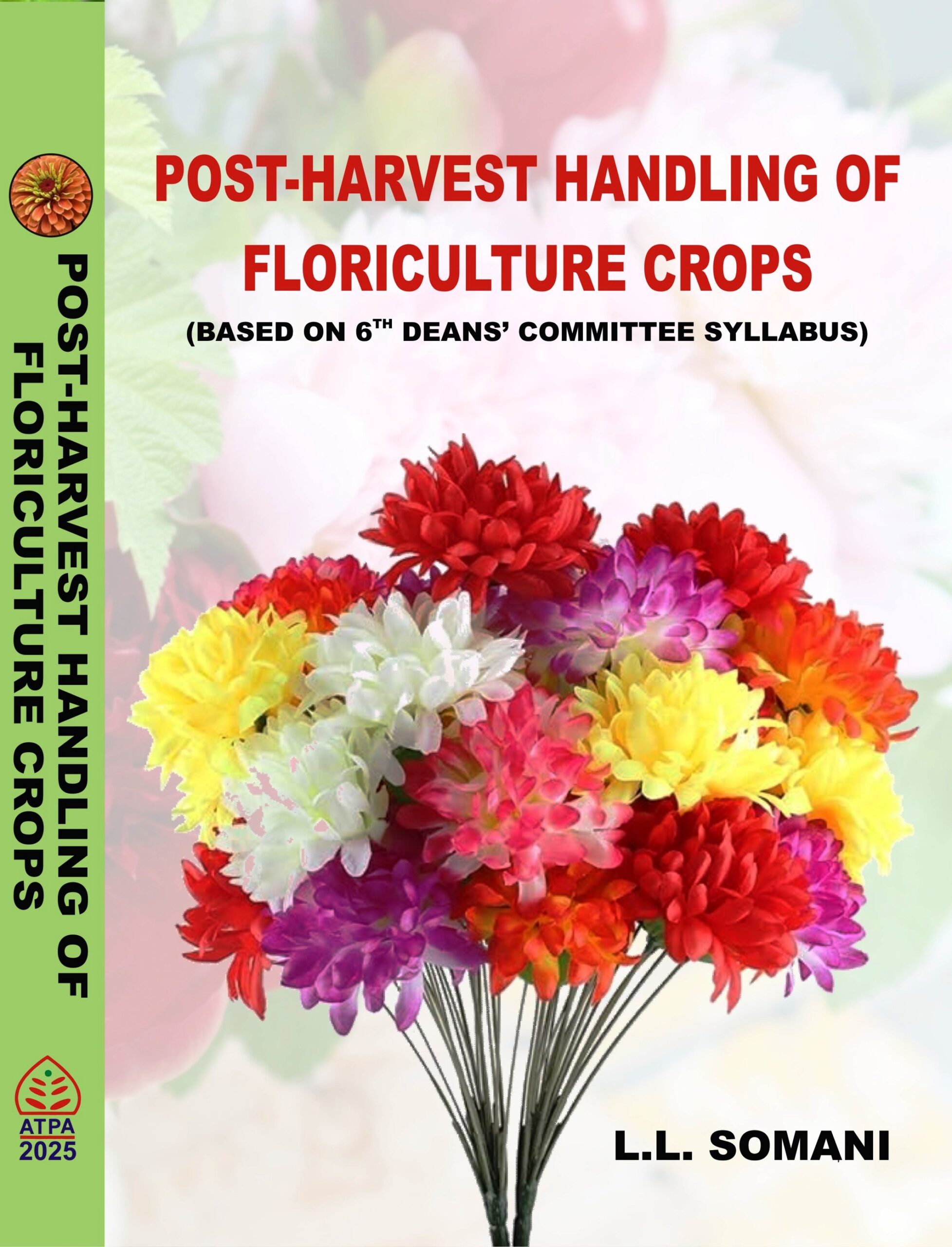
POST-HARVEST HANDLING OF FLORICULTURE CROPS
₹1,980.00
AUTHOR: L.L. SOMANI
PUBLISHING YEAR: 2025
ISBN: 9789348771353
@ALL RIGHT RESERVED
Description
ABOUT THE BOOK
This book explores the post harvest technology and management of cut flower industry in its comprehensive nature. This publication is planned to reveal advances in postharvest technology and management of cut flower industry so that innovations made so far can be judiciously utilized for this sector. The book covers all important aspects related to post harvest technology of cut flowers viz. basic requirements, keeping quality, breeding for longevity, senescence, abscission, use of growth regulators, ethylene and flower longevity, water relations, treatments to enhance flower longevity, ingredients of chemical solutions, safe storage, grading, packing, transport, trade, export etc. The cut flower industry, however, requires the further attention of researchers, industrialists and interpreneurs. I hope this book will be useful to scientists, teachers, students, cut flower growers, traders, industrialists, entrepreneurs, technocrats and planners.
CONTENTS
| S. No. | Title | Page No. |
| Preface | 3 | |
| About the Book | 22 | |
| About the Author | 23 | |
| 1. | PREAMBLE | 24-32 |
| 2. | BASIC REQUIREMENTS FOR CUT FLOWERS
2.1 High Quality Water 2.2 Food Sugars 2.3 Healthy Environment 2.4 Santitation 2.5 Growth Regulaors |
33-38
33 36 37 38 38 |
| 3. | KEEPING QUALITY | 39-40 |
| 4. | VARIABILITY AND BREEDING FOR LONGEVITY | 41-42 |
| 5. | PRE HARVEST CONDITIONS
5.1 Pre Harvest Light and Temperature 5.2 Mineral Nutrition 5.3 Irrigation Frequency 5.4 Plant diseases 5.5 Development Stage and Time of Harvest |
43-46
43 44 45 45 45 |
| 6. | SENESCENCE OF CUT FLOWERS | 47-48 |
| 7. | CHANGES DURING SENESCENCE
7.1 Autolysis of Cells 7.2 Acid Hydrolysis 7.3 Disappearance of Ribosomes 7.4 Respiration & Hydrolysis of Cell Components 7.5 Macromolecular Compounds 7.6 pH of Vacuole 7.7 Degradation of DNA 7.8 Protein Synthesis 7.9 Disruption of Tonopiast 7.10 Free Sterol: Phospolipid mole Ratio 7.11 Carbohydrate and Nitrogen Metabolism |
49-58
49 49 50 50 51 51 51 51 52 52 53 |
| 8. | FLOWER BUD AND PETAL ABSCISSION
8.1 What is Abscission 8.2 Hydrolytic Enzymes 8.3 Petal Abscission 8.4 Pollination and Fertilization 8.5 Weakening of Abscission zone 8.6 Auxin Level |
59-62
59 59 60 60 60 61 |
| 9. | GROWTH REGULATORS
9.1 Improving the Quality of Cut Flowers 9.2 Post harvest Life of Cut Flowers 9.3 Leaf Yellowing and Wilting 9.4 Growth Devetopment and Aging 9.5 Water Loss and Wilting 9.6 Flower Senescence 9.7 Abscission 9.8 Post harvest Life of Cut Flowers 9.9 Auxins 9.10 Cytokinin 9.11 Gibberellins (GA3) 9.12 Abscisic Acid (ABA) 9.13 Ethylene 9.14 Growth Retardants |
63-83
64 64 64 65 65 65 65 66 66 70 74 77 79 81 |
| 10. | COLOUR FADING AND DISCOLOURATION
10.1 Display Quality of Cut Flowers 10.2 Carotenoids and Anthocyanins 10.3 Foliage Discolouration 10.4 Yellowing 10.5 Leaf Parkening |
84-87
84 84 85 85 86 |
| 11. | WATER RELATIONS
11.1 Water Uptake 11.2 Water Deficet |
88-95
88 90 |
| 12. | ETHYLENE AND FLOWER LONGEVITY
12.1 Potential Hazard 12.2 Autocatalysis 12.3 Inhibitor of Ethylene 12.4 Ethylene Production Profile 12.5 Cell Disorganisation 12.6 Permeability of Tonoplast 12.7 Precursor of Ethylene 12.8 Amino Acid Pool 12.9 Methionine Level 12.10 Fungal Infection 12.11 Flower Maturation 12.12 Maturation of Flower Organs 12.13 Lipid Hydro-peroxide 12.14 Environmental Factors 12.15 Auxin Transfer 12.16 Loss of Fresh and Dry Weight 12.17 Hormonal Regulation 12.18 Industrial Ethylene 12.19 Ethylene From Growing Plants 12.20 Controlling Ethylone Levels 12.21 Inhibition of Ethylene Synthesis |
96-106
96 96 97 97 98 98 99 99 99 99 100 100 100 101 101 102 102 102 103 103 104 |
| 13. | INHIBITORS
13.1 Morphactins 13.2 Kermite 13.3 Cyclohexamide 13.4 Maleic Hydrazide (MH) 13.5 Sodium Azide (NaN3) 13.6 Silver Ion |
107-110
107 107 107 108 108 108 |
| 14. | CHEMICAL TREATMENT TO ENHANCE FLOWER LONGEVITY
14.1 Sucrose 14.2 Opening Solution 14.3 Bactericides 14.4 Silver Nitrate 14.5 Silver Thisoulphate 14.6 Chemical for Pulsing solution |
111-115
111 112 113 113 114 114 |
| 15. | PROMOTING KEEPING QUALITY
15.1 Conditioning or Hardening 15.2 Pulsing or Loading 15.3 Impregnation 15.4 Bud opening 15.5 Holding (Vase) Solutions |
116-124
116 119 121 122 124 |
| 16. | INGREDIENTS OF CHEMICAL SOLUTIONS
16.1 Water 16.2 Sugars 16.3 Mineral Solutes 16.4 Germicides 16.5 Organic: Acids and Antioxidants 16.6 Growth Regulators 16.7 Growth Retardents 16.8 Ethylene Inhibetors |
125-141
125 127 128 130 133 135 138 140 |
| 17. | OTHER PRE TREATMENTS
17.1 Stems Excreting Milky Fluid 17.2 Gamma Irradiation |
142
142 142 |
| 18. | SPECIAL PROBLEMS
18.1 Foliage Discolouration 18.2 Geotropic Bending 18.3 Yellowing and Darkening/Foliage Discolouration 18.4 Stem Problems 18.5 Stem with Milky Sap |
143-153
143 146 148 151 153 |
| 19. | SAFE STORAGE OF CUT FLOWERS
19.1 Need for Storage 19.2 Causes for Deterioration |
154-165
155 155 |
| 20. | PROBLEMS ASSOCIATED WITH STORAGE
20.1 Loss of Longevity 20.2 Opening of Flowers to an Unacceptable Stage 20.3 Foliage Yellowing/Foliage Discolouration 20.4 Failure of Buds to Open after Storage 20.5 Spread of Diseases During Cold Storage 20.6 Petal Discolouration |
166-167
166 166 166 167 167 167 |
| 21. | FACTORS AFFECTING STORAGE LIFE
21.1 Post Harvest Growing Conditions 21.2 Stage of Development 21.3 Temperature 21.5 Geotropic Bending 21.6 Stem problems 21.7 Effect of Temperature 21.8 Relative Humidity 21.9 Light 21.10 Ethylene |
168-180
168 169 170 170 172 173 177 177 178 |
| 22. | STORAGE METHODS
22.1 Cold Storage 22.2 Controlled & Modified Atmosphero Storage 22.3 Low Pressure Storage |
181-190
182 186 189 |
| 23. | HARVESTING, GRADING AND PACKAGING
23.1 Harvesting 23.2 Post harvest Handling Chair of Cut Flowers 23.3 Quality 23.4 Packaging of Cut Flowers |
191-210
191 193 198 205 |
| 24. | GLOBAL TRENDS
24.1 Introduction 24.2 A Paying Busirfess 24.3 Consumption of Cut Flowers 24.4 Growth in International Trade 24.5 Production of Cut Flowers 24.6 Trade 24.7 Harvesting Benefits from Rapid Innovations 24.8 Changing World Economics |
211-219
211 211 212 212 213 216 217 218 |
| 25. | EXPORT POTENTIAL
25.1 Introduction 25.2 World Scenario 25.3 Benefits/ Advantages of Cut Flower Production 25.4 Cut-Flower Agri-business 25.5 Evolution of Market 25.6 Export of Flowers and Ornamental Products from India 25.7 Strategies for Boosting Export of Floricultural Products 25.8 Other Exporting Countries 25.9 Global Trading of Cut Flowers and Ornamental Flowers 25.10 Cut-Flowers Suppliers 25.11 Conclusions |
220-263
220 222 226 227 229 240 246 251 252 254 263 |
| 26. | TRANSPORT
26.1 Introduction 26.2 Long Distance Transportation 26.3 Transit Handling of Flour 26.4 Refrigeration Before Packing 26.5 Tight Bud Stage 26.6 Short Term Pulsing 26.7 Use of Ethylene Scrubbers 26.8 Avoid Mixed Shipment with Vegetables 26.9 Refrigeted Transport 26.10 Use of Ice in Packing Boxes 26.11 Fast Cooling Methods 26.12 Precooling During Transportation 26.13 Short Period Transportation by Road 26.14 Use of Plastic Inflated Bags |
264-269
264 264 265 265 266 266 266 266 267 267 268 269 269 269 |
| 27. | References | 270-308 |
| 28. | Subject Index | 309-312 |
ABOUT THE AUTHOR
Prof., Dr. Laxmi Lai Somani (b.1945) has his matriculation from his native town Kapasn located in the Chittorgarh District of Rajasthan, He had his bachelor degree (1966) in Agriculture and masters degree (1968) with honours from University of Udaipur. He took Ph.D Degree in 1974 from Sukhadia University. All through he holds a brilliant academic record securing distinction/honours. He went to Waite Agricultural Research Insititute, Adelaide, Austrialia for undertaking Post doctoral work from 1975-77. He started his carrier as a Research Assistant and rose to the chair of professor in 1989 while serving Rajasthan Agricultural University. He has also served as Principal Investigator and Chief Scientist of ICAR Coordinated Projects besides holding the position of prestigious IFFCO Chair Professor. He has also served GAU, Navsari during 1980-81.Dr. Somani superannuated from the position of Director of Resident Instructions in the Maharana Pratap University of Agriculture and Technology in October 2005. He has guided 15 PG students for their Ph.D and M.Sc.(Ag.).
He has published 60 books and over 270 research/ reviews/ technical articles in national and international journals of repute. He has been honoured by University Merit Award, Dhiru Morarji Memorial Prize and Vijay Shree (India-International Friendship Society). Rajasthan Hindi Granth Academy has honoured him for writing an excellent book in Hindi (Analytical Soil Science). The World Development Parliament also honoured him with honorary award DOCTOR OF SCIENCE.
Additional information
| AUTHOR/AUTHORS | L.L. Somani |
|---|---|
| PAGES | 312 |
| BINDING | Hard Back |
| PUBLICATION YEAR | 2025 |
Related products
-
-
POST-HARVEST TECHNOLOGY & VALUE ADDITION
- ₹1,500.00
-