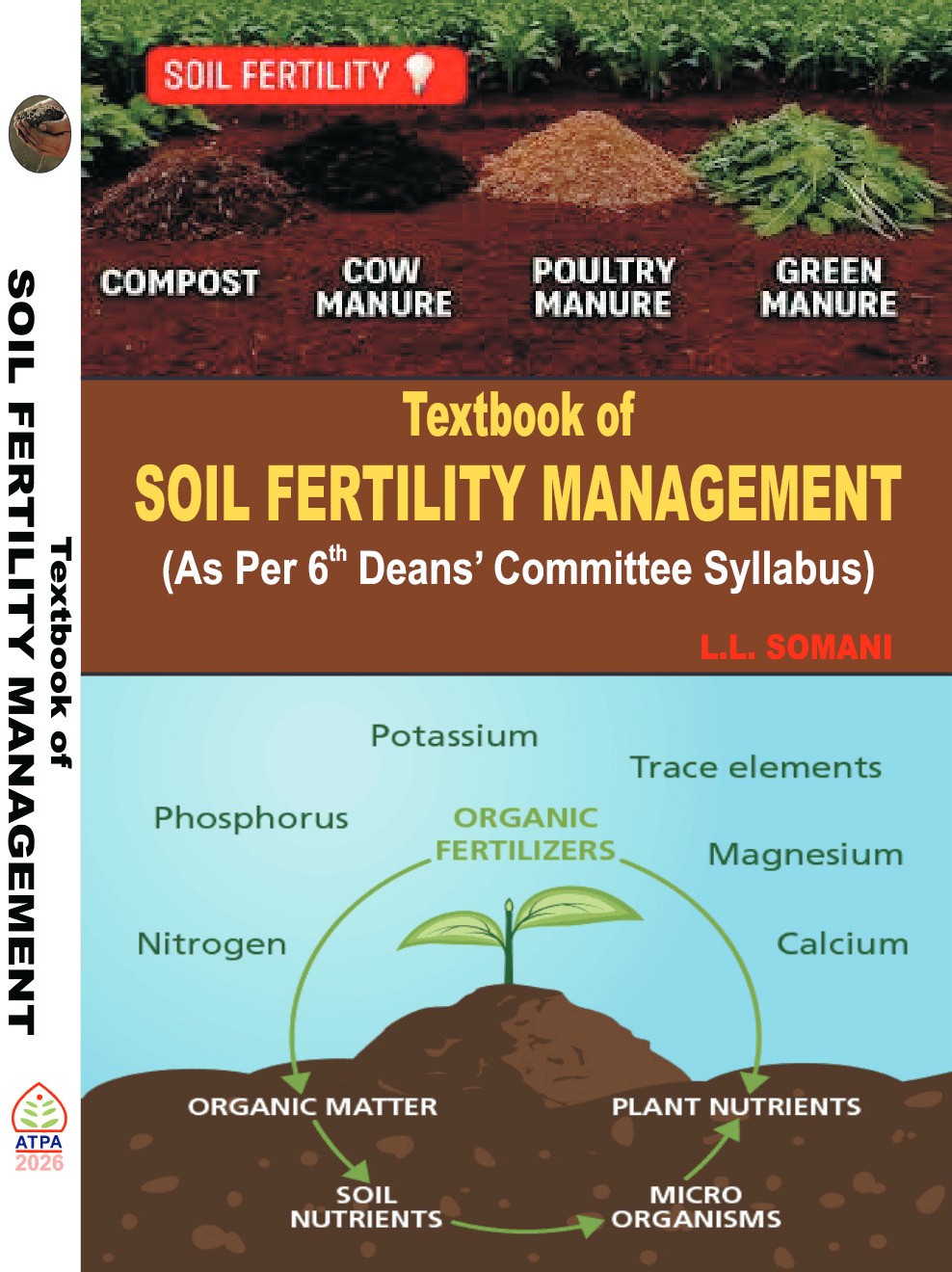
TEXTBOOK OF SOIL FERTILITY MANAGEMENT
₹1,980.00
AUTHOR: L.L. SOMANI
PUBLISHING YEAR: 2026
ISBN: 9789371884297
@ALL RIGHT RESERVED
Description
ABOUT THE BOOK
We’ve already learned that much of the world’s soils are becoming less fertile. But what exactly does soil fertility mean? Some define soil fertility simply as the capacity of the soil to supply nutrients to the plant. Using the definition, a fertile soil one that contains an adequate supply of all the nutrients required for the successful production of plant life.
Fertilization is an important issue because it is needed in order to produce enough food for the increasing population from the decreasing cultivated land, but too much or inappropriate use can be detrimental to the environment.
A productive soil should contain all the essential plant nutrients in sufficient quantity and in balanced proportions. The nutrients must also be present in an available form before plants can use them. Inadequacy of any one of these elements will inhibit plants from growing to their full potential.
This principle is probably best summed by the “Law of the Minimum” Propounded by Justus von Liebig in themed-1800’s This law states that if one of the nutritive elements is deficient or lacking, plant growth will be poor even when all the other elements are abundant. Any deficiency of a nutrient, no matter how small an amount is needed, will hold back plant development. If the deficient element is supplied growth will be increased up to the point where the supply of the element is no longer the limiting factor. Increasing the supply beyond this point is not helpful, as some other element would then be in a minimum supply and become the limiting factor.
No course on soil fertility management would be complete without some discussion of the fundamental reason why we are so interested in managing soil fertility – providing adequate nutrition for plants. It is very important to understand the basic nutritional needs of plants before going on to discuss the best ways to provide these requirements.
This book has been designed to meet the basic requirement of the course recommended by the 4th dean’s committee of ICAR. The book covers the whole syllabus in 16 chapters.
CONTENTS
| S. No. | Title | Page |
| Preface
About the Book About the Authors Literature Cited |
3-4 | |
| 7 | ||
| 8 | ||
| 6 | ||
|
|
History of Soil Fertility & Plant Nutrition | 9-10 |
|
|
Criteria of Essentiality of Plant Nutrients | 11-22 |
|
|
Mechanism of Nutrient Transport to Plants | 23-33 |
|
|
Factors Affecting Nutrient Availability to Plants | 34-38 |
|
|
Chemistry of Macro & Micronutrients | 39-51 |
|
|
Soil Fertility Evealuation | 52-72 |
|
|
Introduction and Importance of Manures & Fertilisers | 73-75 |
|
|
Fertiliser Recommendation Approaches | 76-78 |
|
|
Integrated Nutrient Management | 79-89 |
|
|
Classification of Chemical Fertilisers | 90-96 |
|
|
Complex Fertilisers | 97-98 |
|
|
Customised Fertilisers | 99-102 |
|
|
Water Soluble Fertilisers (WSFs) | 103-106 |
|
|
Nano-Fertilisers | 107-118 |
|
|
Soil Amendments | 119-125 |
|
|
Fertiliser Storage | 126-132 |
|
|
Fertiliser Control Order | 133-141 |
|
|
Methods of Fertilizers Recommendations to Crops | 142-158 |
|
|
Nutrient Use Efficiency | 159-165 |
|
|
Methods of Fertiliser Application Under Rainfed & Irrigated Conditions | 166-178 |
|
|
Carbon Sequestration & Carbon Trading | 179-181 |
|
|
Carbon Trading | 182-185 |
|
|
Preparation & Properties of Major Manures | 186-208 |
ABOUT THE AUTHOR
Dr. L.L. Somani, Retired Director Resident Instructions, MPUAT, Udaipur has many papers published in national and International Journals/ Symposia, etc. and many number of books to his credit in different disciplines of agriculture. He held different position in MPUAT and has spreaded highly innovative ideas and programmes for the development of agriculture.
Additional information
| AUTHOR/AUTHORS | L.L. Somani |
|---|---|
| PAGES | 208 |
| BINDING | Hard Back |
| PUBLICATION YEAR | 2026 |
Related products
-
-
FUNDAMENTALS OF SOIL SCIENCE
- ₹1,980.00
-