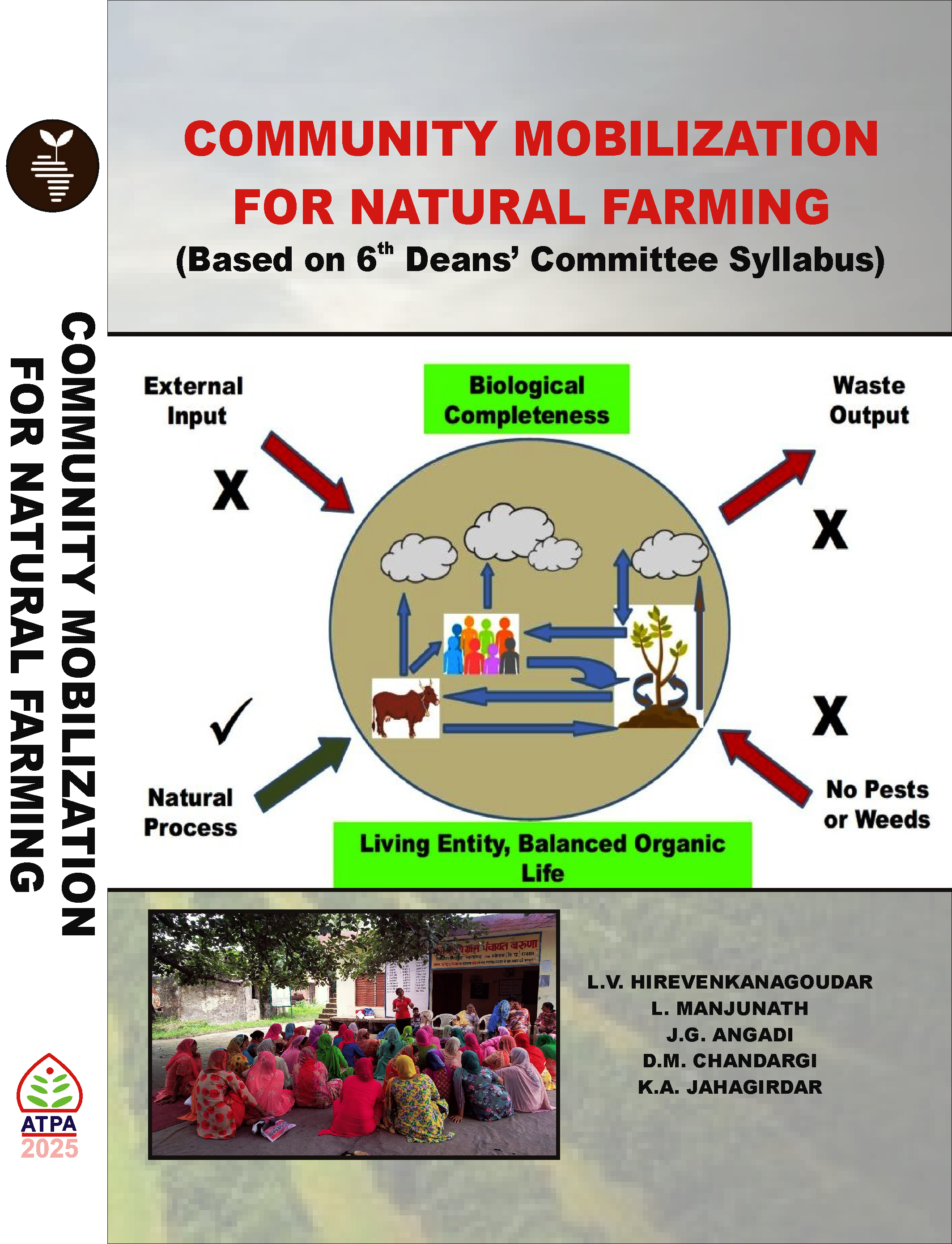
COMMUNITY MOBILIZATION FOR NATURAL FARMING
₹2,980.00
AUTHORS: L.V. HIREVENKANAGOUDAR, L. MANJUNATH, J.G. ANGADI, D.M. CHANDARGI AND K.A. JAHAGIRDAR
PUBLISHING YEAR: 2025
ISBN: 9788119892129
@ALL RIGHT RESERVED
Description
ABOUT THE BOOK
Agriculture is a vital and most productive sector of Indian economy contributing 25 per cent of GDP and employing 65 per cent of country’s work force. In the recent past, Indian agriculture has been poised for transformation in the context of globalization, liberalization and privatization. At the same time, the awareness of the consumer is increasing, who is focal point in the present competitive world. The quality of food is a matter of concern as the modem technology in crop production with the use of pesticides and mineral fertilizers in agriculture has resulted in residues. The standard analytical techniques are being developed rapidly so that more and more residues are detected. Thus, the modern agriculture is posing a global challenge for achieving sustainable development and clean environment.
The farming community and scientific fraternity are looking for the alternatives like organic farming and other holistic approaches with environmentally beneficial practices including the elimination of synthetic chemicals which is receiving considerable attention. In fact, consumers are increasingly demanding environment friendly and healthy foods. India is developing organic farming as an approach for sustainable agriculture, taking into consideration both environmental
concerns and the growing global organic produce market. However, there are obstacles to adopt these holistic approaches in farming. The basic constraints are related to potential yield reduction, cost of conversion and institutional support. The conversion to organic farming can have serious repercussions on food security and lively hoods of marginal and small farmers and farm laborers. Meeting the challenges posed in adopting organic farming involves change in the pattern of public investment and institutional arrangement.
The sustainable agriculture including organic farming is yet to take center stage in agriculture production in India despite agricultural policies waxing eloquent on promoting sustainable farming practices. In the absence of adequate policy support for sustainable and organic farming small farmers are likely to suffer because of high cost of shifting from present farming practices to sustainable one. The result is that much of the small farming system remains much below expectation as low use of chemical inputs is by default rather than part of a systematic choice. Consequently, there is sustained low productivity with continued land degradation due to unscientific farming practices that adhere neither to the recommended practices for chemical use nor for organic and sustainable farming practices. Thus, it is high time for agricultural extension to play its significant role in; creating awareness on various alternatives in farming for sustainable development, also in building motivated human resource to promote organic farming and to have strong institutional arrangements.
This book covers important topics on various alternatives in farming for sustainable development with special emphasis on organic farming.
It also covers extension strategies in promoting organic farming, entrepreneurial competencies, HRD techniques and policy recommendations evolved through interaction among practicing organic farmers, scientists and NGO personnel.
We are sure the book will be of immense use to planners, administrators, extension workers and all those striving for sustainable development through various alternatives in farming with due concern to environment.
CONTENTS
| S. No. | Title | Page |
| Preface | 3 | |
| About the book | 4 | |
| About the Editor | 6 | |
| Our Contributors | 8 | |
| CHAPTER | ||
| 1. | Policy issues in organic farming | 17 |
| 2. | Human resources management: Concepts and Approaches | 33 |
| 3. | Global scenario of organic farming | 39 |
| 4. | Relevance of organic farming to Indian agriculture | 43 |
| 5. | Organic farming – concept, components and practices | 50 |
| 6. | Principles and practices of organic farming | 63 |
| 7. | Cropping systems for organic farming | 76 |
| 8. | Role of Microorganisms (Biofertilizers) In Organic Farming | 84 |
| 9. | Vermi-technology | 89 |
| 10. | Solid waste management | 101 |
| 11. | Environmental aspects of fertilizer use | 104 |
| 12. | Research advances in organic farming | 110 |
| 13. | Strategic management: Concepts and Approaches | 126 |
| 14. | Concept of human resource dev. and its importance in org | 132 |
| 15. | Human resource deveiopment in the new economic environment | 136 |
| 16. | Effective communication for human resource deveiopment | 140 |
| 17. | Empowerment of rural women and organic farming | 147 |
| 18. | Contemporary challenges in organic farming | 151 |
| 19. | Extension strategies for diffusion of organic farming | 155 |
| 20. | Role of participatory rural appraisal for promotion | 164 |
| 21. | Farmers Field School (FFS) | 167 |
| 22. | Participatory technology development in organic farming | 171 |
| 23. | Multimedia – Appropriate tool for promotion of organic farming | 177 |
| 24. | Team building : Concept and Approaches | 183 |
| 25. | Leadership in promotion of organic farming | 186 |
| 26. | Role of creativity and decision making in promoting | 188 |
| 27. | Group dynamics – an effective tool for promotion | 199 |
| 28. | Training need assessment in organic farming | 220 |
| 29. | Use of farm magazine for promotion of organic farming | 226 |
| 30. | Source of involvement and Job satisfaction | 230 |
| 31. | Work motivation | 234 |
| 32. | Entrepreneurial competencies | 238 |
| 33. | Use of organic practices in enhancing crop productivity- experiences of CBTMCP | 244 |
| 34. | Role of NGO in organic farming | 249 |
| 35. | Net working and organic farming | 256 |
| 36. | Market intelligence for promotion of organic products | 264 |
| 37. | Organic farming | 270 |
| 38. | Nutritional value of organic foods | 276 |
| 39. | Value addition to organic products | 281 |
| 40. | SREP approach for promoting organic farming | 285 |
| Subject Index | 290 | |
ABOUT THE EDITORS
Dr. L.V. HIREVENKANAGOUDAR, Professor and Head, Department of Agricultural Extension Education, University of Agricultural Sciences, Dharwad, Karnataka has wide range of contacts
and exposures due to his visits to several foreign countries viz., USA, Mexico, France, South Africa and United Kingdom. He has participated in several national and international seminars, workshops and conferences. He has guided 15 M. Sc. and 10 Ph.D. students.
He has successfully organized a national seminar on Contemporary Challenges for Indian Agriculture and Rural Development and two winter schools viz., Extension Strategies For Human Resource Development In the context of Globalization of Agriculture and Appropriate Extension Strategies For Promotion of Organic Farming.
He is recipient of Best Extension Worker Award of UAS, Dharwad and Indira Priyadarshini Award. He is on the Research Board of Advisors 2000 for The American Biographical Institute, U.S.A. He has published over 125 research papers and 250 popular articles and eight books which includes “Extension Teaching Methods and Communication Technology”, “Extension Approaches for Agriculture and Rural Development” and “Extension Strategies For Human Resource Development”. He is life member of several scientific and statutory bodies and closely associated with many voluntary organizations for the cause of agriculture and rural development. He is specialized in Human Resource Development, Administration, Management and Livelihood strategies.
Dr. L. MANJUNATH, Associate Professor of Agril. Extension, UAS, Dharwad has vast teaching experience, guided 17 M.Sc. students and published over 100 research papers, 120 popular articles, seven books and eight poems. He has received FUWAIaward from the United Writers Association, Chennai. He has participated in many national level training programmes and seminars. He is life member of many scientific journals and several organizations engaged in cultural and rural development. He is specialized in the areas of Agricultural Journalism, human resource development and transfer of technology. Presently, he is working in the publication center of the University.
Dr. J.G. ANGADI, Associate Professor of Agril. Extension, UAS, Dharwad has vast teaching experience, guided many M.Sc. students and published several research papers and popular articles. He has also edited a book. He has participated in many national level training programmes and seminars. He is the life member of several scientific journals and societies. He is specialized in communication and transfer of technology.
Dr. D.M. CHANDARGI, Associate Professor of Agril. Extension, UAS, Dharwad has vast teaching experience, guided many M.Sc. students, published several research papers and popular articles.
He has participated in many national level training programmes and seminars. He is the life member of several scientific journals and societies. He is specialized in leadership and transfer of technology. He has edited two books and published over 50 research papers. He has wide exposure to various national and international organizations and has visited Canada and US under collaborative research activity.
Shri. K.A. JAHAGIRDAR, Assistant Professor of Agril. Extension, UAS, Dharwad has vast teaching experience, guided many M.Sc. students, published several research papers, popular articles and edited one book. He is recipient of India Millennium 2000 Award. He did his post graduation in International Institute of Management, Flenceberg University, Germany. He has participated in many national and international seminars, conferences and summer schools. He is the life member of several scientific journals and societies. He has wide exposure to various national and international organizations and has visited Germany, France, Switzerland and Bangkok. He is
specialized in information Communication Technologies (ICT) and transfer of technology.
Additional information
| AUTHOR/AUTHORS | D.M. CHANDARGI, J.G. ANGADI, K.A. JAHAGIRDAR, L. MANJUNATH, L.V. HIREVENKANAGOUDAR |
|---|---|
| PAGES | 296 |
| BINDING | Hard Back |
| PUBLICATION YEAR | 2025 |
Related products
-
-
PRINCIPLES OF VEGETABLE PRODUCTION
- ₹2,500.00
-
-
-
PRINCIPLES OF HORTICULTURE
- ₹2,500.00
-