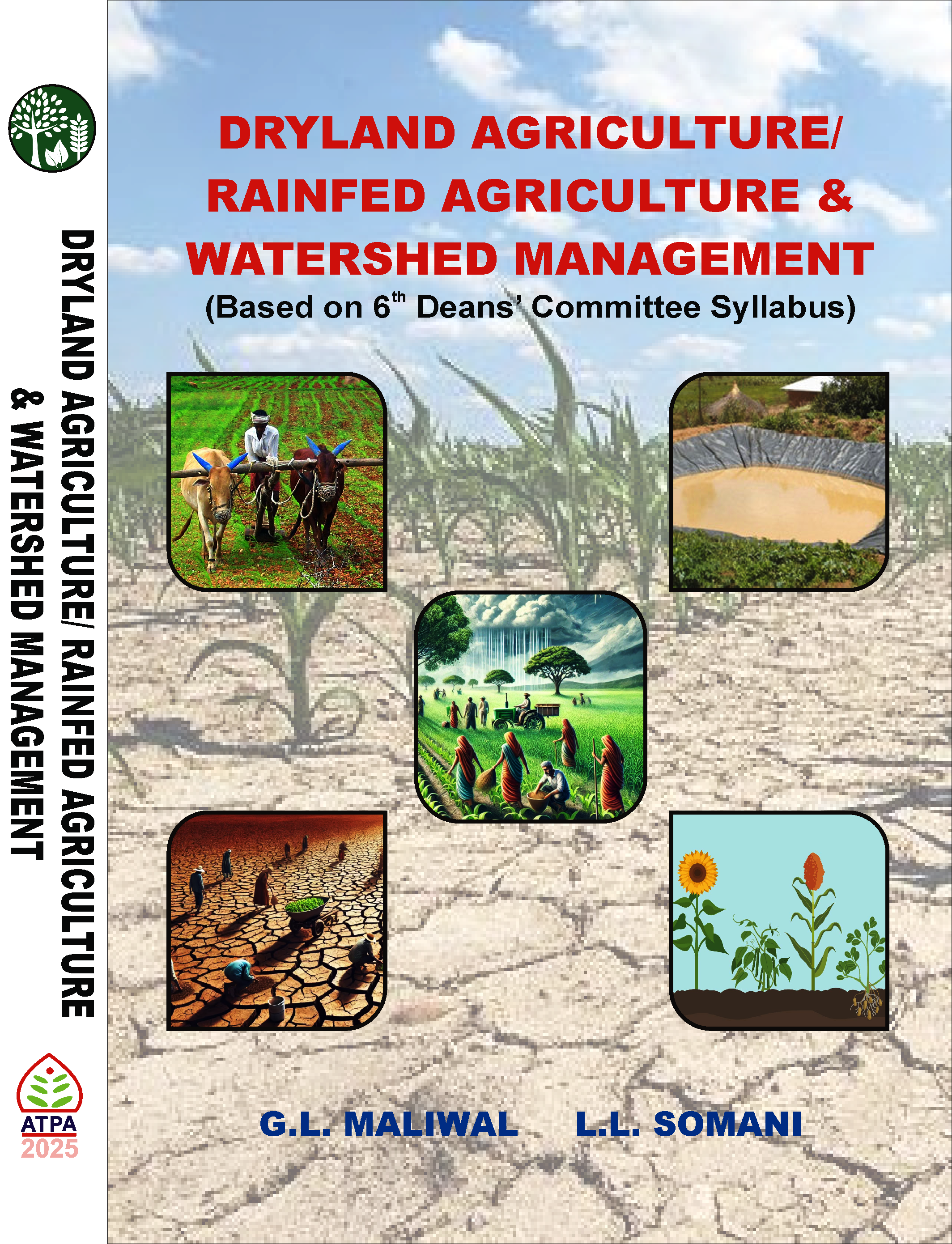
DRYLAND AGRICULTURE/RAINFED AGRICULTURE & WATERSHED MANAGEMENT
₹2,980.00
AUTHORS: G.L. MALIWAL AND L.L. SOMANI
PUBLISHING YEAR: 2025
ISBN: 9788119892792
@ALL RIGHT RESERVED
Description
ABOUT THE BOOK
About 70% of rural population lives in dry farming areas and their livelihood depend on success or failure of the crops. Dryland Agriculture plays a distinct role in Indian Agriculture occupying 60% of cultivated area and supports 40% of human population and 60% livestock population. The contribution (production) of rainfed agriculture in India is about 42% of the total food grain, 75% of oilseeds, 90% of pulses and about 70% of cotton.
It is estimated that even after creating entire irrigation potential for irrigation about 55% of total cultivated area remain as rainfed. Except in the states of Punjab, Haryana and Pondichery the percentage of area under drylands is high in all other states. In Andhra Pradesh the area under drylands is about 6.576 m.ha. (60%). Dry land area in different regions of India.
The productivity of grains already showed a plateau in irrigated agriculture due to problems related to nutrient exhaustion, salinity build up and raising water table. Therefore, the challenges of the present millennium would be to produce more from drylands while ensuring conservation of existing resources. Hence, new strategies would have to be evolved which would make the fragile dryland ecosystems more productive as well as sustainable. In order to achieve evergreen revolution, we shall have to make grey areas (drylands) as green through latest technological innovations.
Drylands offer good scope for development of agroforestry, social forestry, horti-silvi-pasture and such other similar systems which will not only supply food, fuel to the village people and fodder to the cattle but forms a suitable vegetative cover for ecological maintenance.
Realising the importance of dryland farming in the country, all the SAUs have introduced a pertinent course at undergreduate level.
This book is meant for undergraduate level students of agriculture for dryland farming and watershed management course. It will be useful for post graduate students of agronomy and soil science. This book is also useful for officials of agriculture and horticulture departments, who deal with the implementation of dryland and watershed technology at village level.
This book covers all the topics related to dryland farming and watershed management in a simple form. The topics were dealt along with tables, formulae, figures and illustrations for easy understanding of the subject. The suggestions from the readers are welcome to improve the text book.
CONTENT
| S. No. | Title | Page |
| Preface | 3 | |
| About the Book | 6 | |
| About the Authors | 8 | |
| CHAPTER | ||
| 1. | What is Dryland Farming | 11-32 |
| 2. | Characteristics of Environment | 33-72 |
| 3. | Drought and Drought Management | 73-97 |
| 4. | Crop Planning | 98-134 |
| 5. | Mulching | 135-161 |
| 6. | Soil and Crop Management | 162-202 |
| 7. | Water Harvesting | 203-231 |
| 8. | Watershed Management | 232-260 |
| 9. | Glossary | 261-272 |
ABOUT THE AUTHORS
Dr. G.L. Maliwal saw the light of thee day on 16th November, 1942, obtained M.Sc. Ag. From Rajasthan College of Agriculture, Udaipur in 1965 and Ph.D. Degree from University of Udaipur, Udaipur in 1968. Dr. Maliwal had post doctoral research at Moscow State University, Krasnadar, USSR in 1968-1970. During last 38 years of active research and education Dr. Maliwal has made valuable contribution in the field of irrigation water quality, soil salinity, utilization of waste water in agricultural, water management and dry land farming, and guided M.Sc. Ag. and Ph.D. students. He held responsible positions at University of Udaipur, Udaipur (1966-76) and Gujarat Agricultural University (1976-2002). Before retirement, he was principal Investigator of the project on “Use of urban and industrial effluents in agriculture”, GAU, Anand Centre financed by World Bank.
Dr. Maliwal was the active member of different expert committees constituted by state and central government in the field of salinity and pollution.
As a devoted researcher, authentic writer and critical reviewer, Dr. Maliwal has 210 original papers, books, bulletins and popular articles in national and international journals to his credit. He has made more than 80 recommendations for farming community and honoured by Sardar Patel Agricultural Research Award for the year 1988-89 by Givernment of Gujarat, Gandhinagar.
Dr. L.L. Somani (b. 1945) Formerly, Chief Scientist at Agricultural Research Sub-station, RAU, Beechwal, Bikaner (Rajasthan), Dr. Somani has chaired the prestigeous IFFCO professor’s chair for over 15 years at Maharana Pratap University of Agriculture and Technology, Udaipur. He retired from the post of Director Resident Instruction, MPUAT, Udaipur in october 2005. He has published 400 research papers and articles in national and international journals of repute. He is author of Dictionary of Extension Education, Fundamentals of Extension Education, Extension Educations & Communication, Extension Education at a Glance, HB on Programme Planning, Implementation & Evaluation, Extension Methodologies for Transfer of Agricultural Technology, HB on Instructional Technology, Fundamentals of Rural Sociology and Educational Psychology, Extension Education & Rural Development, etc. He has been instrumental in teaching and training of farm families by laying out field demostrations, field days, Radiobroadcasts, TV Telecasts and Print Media. The field experience gained on the farmer’s field has helped to improve technology to suit for adoption by the farmers. Dr. Somani has been honoured with several awards viz. University Merit Award, Dhiru Morarji Memorial Prize (FAI), Vijay Shree and Skiksha Ratan awards by India International Friendship Society. World Development Parliament Honoured him by DOCTOR OF SCIENCE (Honoris causa) for invaluable distinguished services rendered by him.
Additional information
| AUTHOR/AUTHORS | G. L. MALIWAL, L.L. Somani |
|---|---|
| PAGES | 272 |
| BINDING | Hard Back |
| PUBLICATION YEAR | 2025 |